Holes chewed in the leaves
Something has eaten it. Indoors that is a short list, and the shape and position of the damage names the culprit.
What it usually is
1 Caterpillars, on a plant that has been outdoors
| How to tell | Ragged holes with irregular edges, eaten from the middle or the edge of the leaf, with small dark pellets of frass on the leaves below. Look on the undersides and along the midribs, and at night with a torch. |
|---|---|
| The fix | Pick them off by hand and put them outside. Check the plant every evening for a week. A plant brought in from a balcony in autumn is the usual route indoors. |
2 Slugs or snails, on a plant that stands outside or in a porch
| How to tell | Smooth edged holes eaten from the leaf margin inwards, with a silvery slime trail on the pot, the leaf or the surface nearby. Damage appears overnight. |
|---|---|
| The fix | Look under the rim of the pot and beneath the saucer, which is where they spend the day, and move them well away. Standing the pot on a dry surface rather than damp paving removes their shelter. |
3 Vine weevil adults
| How to tell | Neat semicircular notches cut into the edges of the leaves, as though with a hole punch. The adults feed at night. The far more serious damage is below the compost, where the grubs eat the roots. |
|---|---|
| The fix | Tip the plant out and look for creamy grubs with brown heads in the compost. If they are there, wash the roots clean, repot into fresh compost, and treat with a nematode drench in late summer. Notched leaves alone are cosmetic; the grubs are not. |
4 It was not eaten at all
| How to tell | Holes with brown, dry edges rather than clean cut ones, or splits along a natural line in a monstera or a banana. Nothing eats a leaf and leaves a browned rim behind. |
|---|---|
| The fix | Look elsewhere. Brown edged holes are usually old physical damage or a leaf spot that dried and fell out of the middle. A monstera's splits and holes are the plant's own design. |
Through the year. Caterpillars and slugs are a late spring and summer problem and arrive indoors on plants brought in from outside. Vine weevil adults feed from spring to late summer and their grubs do their damage in autumn and winter.
Indoors, a chewed leaf is a short list, and the shape of the hole does most of the work.
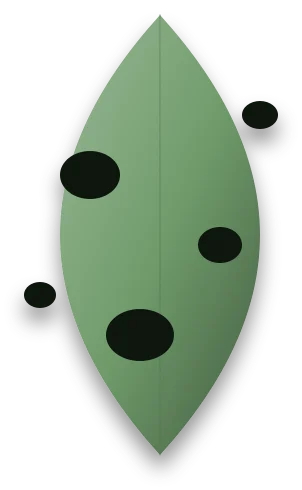
A neat semicircular notch cut from the edge, as though someone had used a hole punch on the leaf’s margin, is a vine weevil adult. The notches themselves are cosmetic. What matters is that where there are adults there are usually grubs, and vine weevil grubs eat roots, which is how a plant goes from looking fine to collapsing in a fortnight. If you see the notches, tip the plant out and look for fat cream coloured grubs with brown heads curled in the compost. Finding them is the point of noticing the notches at all.
A ragged hole in the middle of a leaf, with small dark pellets scattered on the leaves below, is a caterpillar. They are almost always brought in on a plant that has spent the summer outside. Search along the midrib and the undersides, and look after dark, when they feed and are far easier to find.
A smooth hole eaten in from the leaf margin, appearing overnight, with a dried silvery trail somewhere near, is a slug or snail. They come in with pots from a patio and hide under the rim or under the saucer during the day.
And the fourth possibility is that nothing ate it. A hole with a brown, dry rim was not cut by mouthparts: it is old damage, or a leaf spot whose dead centre fell out. A monstera’s holes and splits are the plant’s own architecture. A banana leaf tears along its natural lines in a draught. None of these needs a treatment, only a correct reading.
The habit that prevents most of it is the same one that prevents most pest problems: check a plant over, undersides and compost surface included, before it comes indoors from a balcony or a garden centre, and keep it apart from the others for a fortnight.
Entries that name it
What the journal says about this symptom on each plant.
| Cherry laurel | Bacterial shot-hole, which starts as small brown spots with a water-soaked edge and drops out of the leaf, leaving a ragged hole. There is no effective chemical treatment. Prune out affected growth, avoid wetting the leaves when you water, and ease off on feeding, since soft growth is the most susceptible. |
|---|---|
| Gooseberry | Gooseberry sawfly, whose green, black-spotted larvae strip leaves fast and can appear in several waves from spring through late summer. Check the leaf undersides from mid-spring and hand-pick larvae while numbers are low. A bush usually survives even a complete defoliation and regrows the following year, so treat it as urgent rather than fatal. |
| Laurustinus | Viburnum beetle, whose larvae skeletonise leaves in spring and whose adults cause further damage in late summer. Look for the egg-laden twig tips over winter and prune them out before the eggs hatch. Treating young larvae in spring, as soon as damage is first seen, is easier than dealing with the adults later. |
Questions from the margin
- What is eating holes in my houseplant?
- The shape names it. A neat semicircular notch cut from the leaf edge is a vine weevil adult. A ragged hole in the middle with dark pellets below is a caterpillar. A smooth hole eaten in from the margin overnight, with a silvery trail nearby, is a slug or a snail.
- Why does my leaf have holes with brown edges?
- Then nothing ate it. Mouthparts leave a clean cut. A hole with a dry brown rim is old physical damage, or a leaf spot whose dead centre fell out, and a monstera's holes are the plant's own design.
Checked against RHS, Vine weevil; RHS, Caterpillars on plants.