Spots on the leaves
Fungal, bacterial, cold or sun. Four causes that look alike at first and are told apart by the edge of the spot, where it sits, and whether it spreads.
What it usually is
1 Fungal leaf spot
| How to tell | Round or oval spots, brown or black, often with a yellow halo and sometimes with tiny dark dots in the centre. They appear on the older leaves first and spread slowly, worst where the air is still and the leaves stay wet. |
|---|---|
| The fix | Remove the affected leaves and put them in the bin rather than the compost. Water at the compost and not over the leaves, space the plants so air moves between them, and do not leave a plant standing wet overnight in a cool room. |
2 Bacterial leaf spot
| How to tell | Spots that look water soaked and slightly translucent at first, often angular because they are stopped by the leaf's veins, and they spread faster than fungal spots do. They may smell when the tissue breaks down. |
|---|---|
| The fix | Cut the affected leaves off at once and isolate the plant. Keep the leaves dry, stop misting, and improve the air movement. Badly affected plants are usually best thrown away, because bacterial spot spreads on splashes and on hands. |
3 Cold damage
| How to tell | Pale or dark patches that appeared after a cold night, often on the side of the plant facing a window, sometimes in the exact shape of where a leaf touched the glass. |
|---|---|
| The fix | Move the plant off the sill and away from the glass, especially behind a closed curtain on a winter night. The damage does not spread and does not heal, so remove the worst leaves and let new growth replace them. |
4 Sun scorch
| How to tell | Bleached or papery patches on the leaves facing the window, on a plant that was recently moved into a brighter spot or is behind glass in summer. Only the exposed leaves are marked. |
|---|---|
| The fix | Move it back a metre or diffuse the light with a net curtain, and introduce a plant to stronger light over a fortnight rather than in one afternoon. Scorched tissue does not recover, but the plant does. |
Through the year. Fungal and bacterial spots are worst in the damp still air of late autumn and winter. Scorch belongs to spring, when the sun strengthens faster than people move their plants.
Spots are the symptom with the widest set of causes, and the way through is to look at three things before deciding: the edge, the position and the progress.
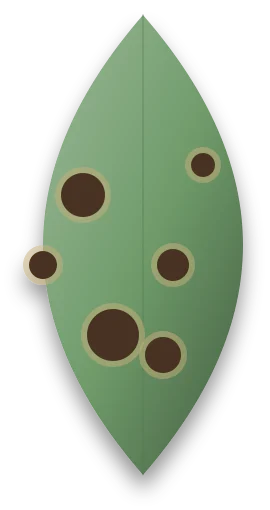
The edge tells you the most. A spot with a definite margin, round or oval, often ringed in yellow, is usually fungal. A spot that looks wet, translucent and angular, following the straight lines of the leaf’s veins, is usually bacterial. A patch with a soft indefinite edge, pale and papery, is physical damage from sun or cold rather than an organism.
The position tells you the next most. Damage on the side facing a window is light or cold. Damage on the oldest leaves, low down and inside the plant where air does not move, is fungal. Damage scattered across new and old growth alike, spreading week by week, is bacterial and is the one to act on quickly.
Progress settles it. Sun and cold damage appear once and stay exactly as they are. An organism spreads. If you photograph a spotted leaf and compare it with the same leaf a week later, you will know which you have.
The treatment for the two living causes is mostly about water and air rather than about a bottle. Fungal and bacterial spots both need leaf surfaces to stay wet to establish, so watering at the compost instead of over the plant, giving pots enough space for air to move between them, and never leaving a plant wet overnight in a cool room prevents most of it. Remove affected leaves, wash your hands before touching the next plant, and put the leaves in the bin.
Fungicides sold for houseplants are of limited use once spots are established, and none of them repairs a marked leaf. The honest approach is to remove what is affected, change the conditions that allowed it, and let the plant grow clean leaves. If more than about a third of a plant is spotted and spreading, it is usually kinder to the rest of the shelf to throw it away.
Entries that name it
What the journal says about this symptom on each plant.
| African violet | Cold water or droplets left on the hairy leaves in sunlight. Water from below with tepid water and keep the leaves dry. The pale rings are permanent and the leaves have to grow out. |
|---|---|
| Blackberry | Leaf and cane spot, purplish marks on canes and leaves that fade to tan-brown with a paler centre. Prune out infected canes, clear fallen leaves rather than leaving them, and improve airflow around the planting. A fungicide is rarely needed unless it recurs badly year on year. |
| Chinese evergreen | Cold water splashed on the leaves, or a fungal leaf spot in still damp air. Water the compost with tepid water rather than the foliage, and improve the air movement around the plant. |
| Christmas cactus | Sunburn on segments that were moved into direct sun. Move it back into bright indirect light. Bleached segments do not recover and can be removed as new ones grow. |
| Escallonia | Escallonia leaf spot, a fast-spreading fungal disease showing as purple-black spots with a greyish centre, worse in wet weather. No fungicide is recommended for it. Remove and bin affected leaves, including fallen ones, and cut a badly affected plant back hard to stimulate clean new growth; keep the plant well fed and watered so it can outgrow the disease. |
| Fiddle-leaf fig | Bacterial leaf spot, which spreads on wet leaves in still air. Remove affected leaves, water the compost rather than the foliage, and give the plant more air movement and more light. |
| Garden privet | Privet thrips, tiny brownish insects that feed on the leaf surface from about May to October and leave a grey, silvered stippling. An established hedge usually shrugs off the cosmetic damage. Encourage the predatory insects that feed on thrips rather than spraying, which does more harm to the garden than the thrips do. |
| Mint | Mint rust, which shows as bright orange pustules on the undersides. Cut the plant to the ground, bin the material rather than composting it, and do not take cuttings from an affected plant. |
| New Zealand broadleaf | Leaf spot, an occasional problem on a plant that RHS otherwise describes as generally pest and disease free. Remove affected leaves and improve air circulation around the hedge. It is rarely serious enough to need more than that. |
| Photinia | Entomosporium leaf spot, which starts as small bright red spots on young leaves and can spread to large purple-maroon blotches. No cultivar is resistant. Space plants for airflow, water at the base rather than overhead, and rake up and bin fallen leaves rather than composting them, since that is where the disease overwinters. |
| Tomato | Blight in a wet season, showing as brown patches with a pale halo that spread fast, or an early leaf spot. Remove affected leaves at once, water at the base rather than over the plant, and give it air. Outdoor plants in a wet summer are the ones at risk. |
| Yucca | Fungal leaf spot, which follows water left standing on the leaves in a cool room. Water the compost rather than the plant, improve the air movement around it, and remove the worst leaves. |
Questions from the margin
- What causes spots on houseplant leaves?
- Four things, told apart by the edge of the spot. A defined round margin, often ringed in yellow, is fungal. A water soaked angular patch stopped by the veins is bacterial. A soft pale patch with an indefinite edge is sun or cold damage, which appears once and never spreads.
- Do leaf spots spread to other plants?
- Fungal and bacterial ones can, on splashes and on hands. Remove affected leaves into the bin rather than the compost, wash your hands before touching the next plant, water the compost rather than the foliage, and give the pots room for air to move between them.
Checked against RHS, Leaf spot on houseplants; Penn State Extension, Foliar diseases of houseplants.