How to organize a dresser and its drawers
About 7 minutes to read. Published . By the House & Hedge team.
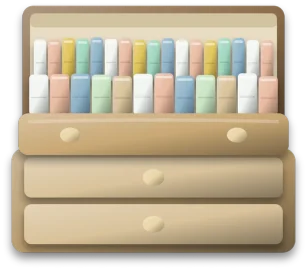
A dresser fails the same way a closet does: too much in it, and no fixed place for anything. Clothes are stacked flat, so the one you want is always at the bottom. You dig for it and pull the others out of line, and the drawer is back in disorder by the end of the week. The fix is cheap. Give each drawer a job, fold clothes so they stand up in rows, and put in dividers that suit the clothes you own. This guide covers each of those, then socks and underwear, then the junk drawer, which needs a rule of its own.
If the closet is a mess too, start there with the closet guide. A sorted closet tells you how much has to fit in the dresser.
Empty one drawer at a time
Do not empty the whole dresser at once, or you will be standing in a room full of clothes at nightfall. Start with the drawer that annoys you most. Tip it onto the bed, wipe out the inside, and sort what came out into keep, mend and let go, the same way the closet guide does. Anything that is not clothing goes in a separate pile for later.
Wiping the drawer matters. Dust and lint collect at the back and in the corners. If wool lives in the dresser, the corners are also where moth larvae hide. UC IPM advises vacuuming and washing the interior of a closet, especially the cracks, before clean items go back, and a drawer is a small closet.
Give each drawer a job
Name the job before anything goes back in. A common split for a five drawer dresser:
- Top drawer: underwear, socks, bras and anything small. It is the drawer you open most, so it is the one at the best height.
- Second drawer: t-shirts and tops.
- Third drawer: trousers, shorts and leggings.
- Fourth drawer: heavy knits and sweatshirts.
- Bottom drawer: the seldom used: sleepwear for another season, gym gear, spare linens.
A different count of drawers works the same way. The point is that you never have to think about where a shirt goes. If a drawer holds two jobs, divide it in half with a divider and say which half is which.
Fold so everything stands up
The best fold for most clothes is the one that lets each item stand on its edge, with the folded edge facing up. You then see every piece from above, the way you see files in a cabinet, and you can lift one out without disturbing the rest.
- Lay the item flat and smooth it.
- Fold the sides in so the item is a long rectangle. For a t-shirt, bring each side in to the middle, with the sleeves tucked back along them.
- Fold the rectangle in half or in thirds, until the folded piece is a little shorter than the inside height of the drawer, so the drawer closes over it.
- Stand it on its edge, with the folded edge up and the front of the item facing you.
- Fill the drawer in rows, front to back, with the pieces touching so they hold one another up.
Three exceptions:
- Heavy sweaters. Fold them in half once and then in thirds, and stack them flat, no more than three or four high. Woolmark says that drying a knitted garment on a hanger can stretch it, and a heavy knit is better supported flat than hung.
- Soft, thin items, such as pajamas and gym clothes, can be rolled into tight cylinders and stood in a row. They take little room and show well.
- Delicates, such as silk and lace, fold into a loose pouch with tissue between the folds.
Refold now and then
UGA Cooperative Extension says of textile heirlooms that cloth tends to split where consistent creases and pressure are placed, and advises repositioning the folds several times a year. Everyday clothes are not heirlooms, and a shirt that is worn out in ten years has not suffered. But the reading carries over: a fold in the same place for years is where a worn thin spot appears. When you refold at the seasonal change, fold a long-stored item with a different crease from last time.
Dividers
Dividers are what stop standing folds from tipping into one another. Two kinds work.
- Adjustable dividers are slim panels that spring against the sides of the drawer, so they fit any width. They suit a drawer with long rows of tops or trousers.
- Small bins and trays hold items that do not stand up by themselves, such as socks and underwear.
Measure the drawer’s inside width, depth and height before you buy anything. Subtract a little from the height, so the drawer closes over the tallest fold. A shoe box lid, a cutlery tray or a folded cardboard sleeve is as good as a bought divider for a first attempt, and you can see what works before you spend money.
Socks and underwear
The smallest drawer is the one that takes the most digging, so give it small compartments.
- Socks. Match them in pairs and lay each pair flat, one on the other, then fold the pair once. Stand them in a row. Put sports socks, dress socks and everyday socks in separate rows.
- Odd socks. Keep one bag for socks that have lost a partner, and set a date. If the partner has not turned up in two weeks, bin or rag the sock.
- Underwear. Fold in thirds and stand in rows. Do the same with tights, folded into a flat square.
- Bras. Lay them flat with the cups nested one inside the other, and keep them in a row in their own tray.
- Worn-out items. Underwear and socks with a worn elastic or a hole are the easiest decision in the drawer. Let them go. Put them in the textile recycling stream if there is one near you. The US EPA reports that clothing and footwear textiles were recycled at a rate of 13 percent in 2018, so most discarded clothing is not recycled.
Wool in the drawers
Sweaters are the usual victims of moths. UC IPM says clothes moth larvae feed on wool clothing, and can attack synthetic or cotton blends that contain wool, and that the damage is usually hidden, under collars and cuffs. Before a sweater goes into a drawer for the season, wash it as its label says, dry it fully, and check the collar and cuffs. The guide on washing wool without shrinking it covers the washing. The guide on getting rid of clothes moths covers what to look for and what to do if you find signs.
UGA Cooperative Extension advises against storing cotton, linen and rayon textile heirlooms in cedar chests. A cedar-lined drawer is not a reason to leave those fabrics in it for years.
The junk drawer rule
Every home has one drawer for the things that belong nowhere else: tape, pens, scissors, keys, takeout menus, batteries, a tape measure, the instruction booklet for something that was thrown out. The drawer is fine. The trouble is when there are three of them.
The rule has four parts.
- One junk drawer in the house, in the kitchen or near the door. Everything else needs a proper home.
- Trays. Sort the contents into a cutlery tray or a set of small boxes: writing tools, tape and glue, tools, keys and tags, and one tray for everything else. If something does not fit a tray, it does not belong in the drawer.
- A limit. The drawer must close without being pushed. When it does not, clear it out.
- A date. Sort it every three months. Anything you do not remember needing goes.
What never goes in the drawer
Used batteries. The US EPA says used lithium-ion batteries should not go in household garbage or recycling bins, and that even used batteries can have enough energy to injure or start fires. Its advice is to place non-conductive tape, such as electrical tape, over the battery’s terminals, and to seal each battery in its own plastic bag. Keep a small lidded tin by the door for used batteries, with a roll of tape beside it, and empty it at a drop-off point. The EPA lists Earth911 and Call2Recycle as places to look for one. For devices with built-in batteries, it points to certified electronics recyclers, retailers with take-back programs, or the local household hazardous waste program.
Chargers and cables are the other junk drawer filler. They have their own method in the guide to cables and chargers.
Keeping it
A drawer stays organized if it is easier to put things back than to leave them out. Fold on laundry day, when the drawer is half empty and the clothes are warm from the dryer. When something new comes in, something goes out. And when a row starts to lean, stop and straighten it, because a leaning row is the first sign that the folds are too big for the drawer.
For sheets and towels, the next job is the linen closet.