How to get rid of clothes moths
About 9 minutes to read. Published . By the House & Hedge team.
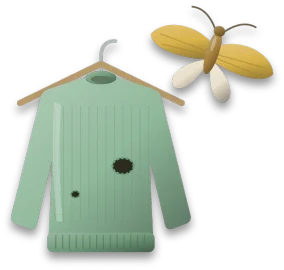
The moth you see in the bedroom is rarely the problem. The damage is done by the larvae, small pale caterpillars that live hidden in the fabric, and both UC IPM and Virginia Cooperative Extension say it is the larvae and not the adults that eat wool. By the time a hole shows, the larvae may have been feeding for months. This guide goes through how to confirm that it is clothes moths, how to clear the clothes, the closet and the room, and how to keep wool safe afterward. It does not rely on sprays. UC IPM puts washing, cleaning, freezing and tight storage first.
Confirm what you have
Clothes moths are small. UC IPM describes a webbing clothes moth as gold, with a fringe of golden hairs, about 1/4 inch long at rest and with a wingspan of about 1/2 inch. It has reddish-golden hairs on top of its head. It flies weakly, in a flutter, and it is not drawn to lights. The casemaking clothes moth is browner, with faint dark spots on the wings. Virginia Cooperative Extension describes the adults as very small, buff-yellow to slightly gold moths with narrow wings, and says the casemaking adults are not attracted to lights and usually hide when disturbed.
Pantry moths, the kind that come from flour and grain, are different. UC IPM says food and grain moths are about twice the resting length of clothes moths, have no tuft of hair on the head, and fly directly and steadily around the house. The guide to pantry moths covers them. To be certain, catch a moth and look at its head with a hand lens.
The larvae and the damage
The larvae of both clothes moths look nearly the same: shiny white, with dark head capsules. The webbing moth’s larva spins silken feeding tubes and leaves them behind. The casemaking moth’s larva carries a silken case that it enlarges as it grows, and Virginia Cooperative Extension says the first sign is often tiny caterpillars crawling out of boxes and bags that contain wool.
UC IPM says the damage is usually hidden: under collars and cuffs, in the crevices of upholstered furniture, and under carpet beneath furniture. The signs are silken tubes or mats that contain fibers and droppings, grazing on the surface of the fabric, and holes. On fur, the hairs are clipped at the base. Virginia Cooperative Extension says they leave numerous pellet-like droppings.
What they eat
Between them the two sources list what the larvae eat: wool clothing, carpets and rugs, upholstered furniture, fur, feathers, animal hides, animal-bristle brushes and piano felts. UC IPM says they can attack synthetic or cotton blends that contain wool. Items stained with food or body oils are particularly attractive, Virginia Cooperative Extension says, and UC IPM says stained fabrics are more vulnerable. Virginia Cooperative Extension says they do not attack carpets made of synthetic material, and that carpet beetle larvae also damage wool, so a hole is not proof of moths.
How they got in
UC IPM does not say how an infestation arrives. It says moths may first establish on woolen garments or scraps that are stored for a long time. Virginia Cooperative Extension lists wool carpets, blankets and clothing, hides, and items made from bird feathers, and says outdoors the larvae live in animal nests and dens.
On timing, the two sources differ, and the differences matter little in practice. UC IPM says a female lays about 40 to 50 eggs, that the larval stage can last from 35 days to 2.5 years, and that egg to egg takes 4 to 6 months. Virginia Cooperative Extension gives a life cycle of about 65 to 90 days. Either way, one overlooked sweater can restart the problem.
Step one: find the source
Take everything out of the closet and drawers and look. Examine wool, fur and anything stained, and look under the collar and cuffs. Lift wool rugs and look underneath. Virginia Cooperative Extension advises moving furniture to reach all of the carpet, since clothes moths prefer dark, protected areas.
A pheromone trap helps with both finding and reducing. UC IPM says these traps release a sex attractant that draws male moths to sticky sides. They are specific to clothes moths, and traps for food moths will not catch them. They are very useful for detecting an infestation, and trapped males cannot mate, which gives some control. Put them in closets and storage areas. UC IPM says they do not solve an infestation alone, and that you should combine trapping with laundering or dry cleaning to protect exposed clothes.
Step two: treat the clothes
Treat every item that could hold larvae or eggs.
- Launder. UC IPM says laundering is the most effective way to kill every stage in washable items. Use water at least 120 degrees Fahrenheit for 20 to 30 minutes. Clean fabrics are also less attractive to feed on.
- Dry clean woolens that cannot take hot water. UC IPM points to a dry cleaner for these, and many wool sweaters cannot take water that hot. The guide on washing wool without shrinking it covers the wool that the label allows you to wash.
- Freeze. Seal the item in a plastic bag and freeze it at a temperature lower than 18 degrees Fahrenheit. UC IPM says several days, and Virginia Cooperative Extension says 24 hours. The sources differ, so use the longer time.
- Heat. UC IPM says to heat an item in an oven above 120 degrees Fahrenheit for at least 30 minutes, and Virginia Cooperative Extension says 120 degrees for 30 minutes, or all day in a hot vehicle on a sunny midsummer day. UC IPM says to check first whether heat or cold would damage the fabric.
- Sun and brush. UC IPM suggests hanging woolens in sunlight and brushing them thoroughly, especially seams, folds and pockets, since larvae avoid bright light.
- Dry ice. Both sources describe dry ice as a way to fumigate items in a closed container, and Virginia Cooperative Extension warns that direct contact with dry ice may damage an item’s surface. UC IPM says to use a 4-mil plastic bag with half a pound to a pound of dry ice, keeping the top loosely closed until the ice has vaporized, then sealing the bag and leaving it for 3 to 4 days, and warns that dry ice will freeze bare skin. It also says dry ice kills every stage but does not prevent reinfestation.
After any heat or cold treatment, Virginia Cooperative Extension says to shake and brush the items out thoroughly to dislodge dead larvae and webbing.
Step three: clean the space
UC IPM advises vacuuming under heavy furniture, along baseboards, in cracks, in closets, and inside and behind heaters and vents, and disposing of the bag contents right away because they may hold eggs, larvae or moths. Wash the closet interior, especially the cracks, before clean clothes go back. It also says that keeping indoor humidity low and sealing tiny cracks makes a building less favorable to them.
Repeat the inspection in a few weeks. UC IPM advises monitoring fabrics and closets regularly so you can act while infestations are small.
Step four: store clothes so it does not happen again
UC IPM advises storing only clean, pest-free items in airtight containers. Virginia Cooperative Extension suggests a tight-fitting chest or an airtight plastic container for wool items, and advises cleaning all wool clothing and other woolen items at least once a year, following label precautions, and inspecting other vulnerable items yearly.
Mothballs and cedar
UC IPM warns that mothballs, flakes and crystals made with 1,4-dichlorobenzene (paradichlorobenzene) are toxic, and that they must be kept away from children and pets. They leave an odor on fabrics and can soften or melt plastic buttons, hangers and garment bags. The vapors reach the needed concentration only in an airtight container. Virginia Cooperative Extension also mentions moth flakes and mothballs, and advises airing the items outdoors before use to remove the smell. Use them only as the product label directs.
Cedar is a weaker defense. UC IPM calls it debatable, and both sources say that cedar oil kills small larvae but not large ones and fades. Virginia Cooperative Extension warns that cedar oil applied directly to clothes may stain them.
What about insecticides?
UC IPM puts sprays and dusts after the methods above. It says dusts containing pyrethroids or pyrethrins can be applied in cracks and crevices, following the label. It says to use sprays when items cannot be cleaned, heated, frozen, cold-stored or fumigated with dry ice, to choose a product that lists clothes moths on its label, and to follow the directions exactly. Do not use oil-based sprays on silk, rayon or easily stained fabrics, test a small hidden area first, and do not spray the surface of furniture and expect it to reach moths inside the stuffing. UC IPM does not recommend protective sprays on furs.
When to call a professional
UC IPM says most people can manage clothes moths themselves, but that widespread or heavy infestations often require the services of a professional pest control applicator. For infested upholstery stuffing, a pest control or storage firm can fumigate in a vault. Furs can go to commercial cold storage, and damaged piano felts need a piano technician.
Safety with moth products and sprays
Read the label before you use any product, and follow it. The EPA’s advice is to “always read the label first and follow the directions to the letter, including all precautions and restrictions.”
- Children and pets. The EPA says to “Keep pets and children away from areas where pesticides have been applied.” UC IPM says mothballs and crystals must be kept away from children and pets.
- Storage. “Store pesticides in their original containers.” The EPA warns that “Children and others have been poisoned by accidentally consuming pesticides stored in food or beverage containers.”
- If someone swallows a moth product. The EPA’s advice is to “Keep the telephone number of your area Poison Control Center near your telephone: 1-800-222-1222.”
- Pets. If a pet may have eaten mothballs or a spray, call a vet or an animal poison line at once. The numbers are in the guide on what to do if a pet eats a plant.
The closet itself is the next job. The guide to organizing a closet covers the seasonal swap that keeps clean clothes clean.