Choosing a hedge for privacy and screening
About 11 minutes to read. Published . By the House & Hedge team.

Most hedging advice is organised by plant name, which answers a question nobody actually asked. The real question is a job: block a view, mark a boundary, cut wind, or edge a bed, and different plants suit each job in ways a simple list of species obscures. Sort by function first, then choose the plant, and check its ordinary problems and eventual size against the site before committing to a run of twenty or thirty of the same thing.
A fast privacy screen
If the job is height and density as quickly as possible, privet and cherry laurel are the two most reached-for answers, both reaching four metres or more if never checked and both needing at least one hard trim a year to stay dense rather than leggy. Privet takes full sun or part shade equally well and tolerates almost any soil; cherry laurel is the one to choose for a shaded boundary under trees, where privet thins out and laurel does not, and its much larger leaves give a bolder, more solid-looking screen for the same linear length of hedge.
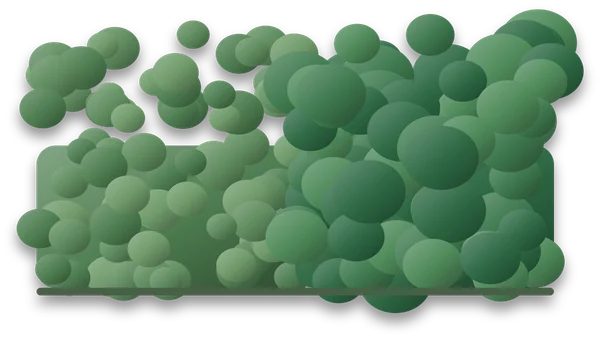
The cost of that speed is upkeep. A fast hedge left unclipped for even one season stops being a hedge and starts being a row of small trees, and both plants are prone to their own particular problems: privet to honey fungus, which has no chemical treatment and can spread to whatever is planted after it, and cherry laurel to a bacterial shot-hole disease that leaves the leaves ragged with holes. Neither problem should rule the plant out on its own, since both remain among the most reliable fast screens available, but they are worth knowing about before a hedge goes in rather than discovering them years later.
A low, clipped edge
For a formal line under a metre, box is still the standard, tolerant of the tight, repeated clipping that a low formal hedge needs and slow enough that it holds a crisp shape between cuts without the constant maintenance a fast-growing plant would need at the same height. Where box blight is a known problem locally, smaller escallonia cultivars or a dwarf, hard-pruned Griselinia are workable substitutes, though neither takes quite as tight a clip and both read as a slightly softer, less architectural line than box does.
The trade-off with any low, tightly clipped hedge is exposure. A plant kept small and dense at eye level or below gets far more scrutiny than a tall screen glimpsed from a distance, so a low hedge with an occasional disease problem shows it more obviously than a tall one would, and is worth checking more often as a result.
A windbreak or coastal screen
Griselinia is the specialist choice here, bred by nothing more than its own origin on the wind-exposed coast of New Zealand to shrug off salt-laden gales that would scorch most other hedging. It needs a reasonable start, decent soil and some shelter for its first year or two while the leaves toughen up, but an established Griselinia hedge is one of the more wind-hardy options available, growing at a useful 40 to 60 cm a year once past that establishment period and otherwise needing almost nothing done to it: RHS describes it as generally free of pests and disease, which is a genuinely rare thing to be able to say about a hedging shrub.
A flowering screen
Laurustinus does something most screening plants cannot: it flowers through the darkest part of the year, in late winter and into spring, when almost nothing else in the garden offers colour, and asks for very little in return beyond an occasional light shaping cut done straight after that flowering finishes. Photinia offers a different kind of colour, not from flowers but from the bright red new growth that follows every trim, which makes it as much a foliage feature as a screen. Escallonia is the true summer-flowering equivalent to laurustinus’s winter show, at the cost of needing its pruning timed carefully around the flowers rather than done whenever convenient, since a hard cut at the wrong time removes the wood the flowers would have grown from.
The indigenous, water-wise option
Readers gardening in South Africa have a genuine additional choice most hedging guides do not mention: an indigenous or naturalised, low-water flowering screen instead of an imported evergreen. Plumbago and Duranta both fill that role, drought resistant once established and suited to a warm, dry summer without the irrigation an imported laurel or privet would want in the same conditions, flowering for most of the warm half of the year rather than for a single season. The trade is frost tolerance: both die back hard, or die outright, in a real frost, which rules them out of a cold-winter garden regardless of how well they suit the water budget, and Duranta carries a further caution worth weighing seriously rather than in passing, since its berries and leaves are confirmed dangerous to pets and children by both a university extension service and a published veterinary case series. Where young children or pets that chew plants are part of the picture, Plumbago is the safer of the two on the evidence available, since nothing found for this entry rated it as confirmed toxic in the same way.
Working out how much hedge you need
Once the job and the plant are chosen, the finder’s filters help narrow a shortlist by light, size and pet safety the same way they do for an indoor plant, and the finder is worth a pass before committing to a species, since a site’s actual light and space rule plenty of options out before price or appearance do. Roughly measuring the run of boundary to be screened, and checking a candidate plant’s likely spacing against it, gives a realistic plant count before any of them are bought, which matters more for the slower, pricier choices like box than for a cheap, fast privet run.
Mixing more than one species
Nothing requires a single-species hedge, and a boundary that changes character along its length, sunnier at one end, more sheltered at the other, is often served better by two plants suited to those two conditions than by forcing one plant to cope with both. The main argument for a single species is visual consistency; the main argument against it is that a disease or pest problem specific to one plant then threatens the whole run rather than just a section of it. A mixed native hedge, several species planted together rather than alternated in a strict pattern, is a third option worth knowing about where wildlife value matters as much as screening, though none of the plants in this cluster were researched specifically for that purpose and a dedicated native hedging mix is a different brief entirely.
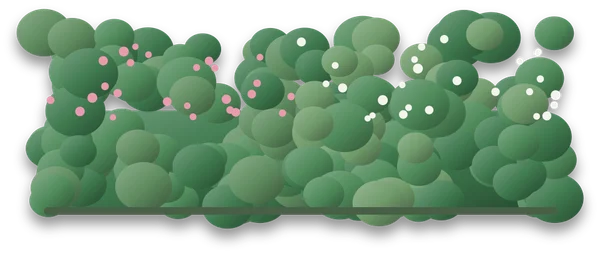
The one question worth asking before any of the above
How much of the year does this need to be private. A garden used mainly in summer can accept a deciduous hedge that is bare for a few months, or a frost-tender flowering screen that dies back over a cold winter; a street-facing window that matters in December cannot accept either. Answering that first narrows the list faster than comparing individual species does, and it is the question every one of the choices above ultimately comes back to.