Dwarf or standard, and does it need a partner
About 10 minutes to read. Published . By the House & Hedge team.
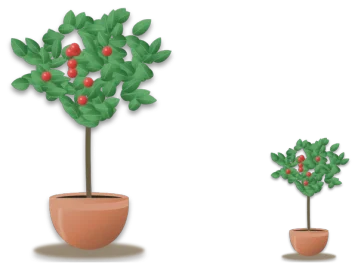
Two separate questions get conflated more often than almost anything else in fruit growing: how big will the tree get, and does it need another tree nearby to actually produce fruit. The first is answered by the rootstock. The second is answered by the variety’s pollination group. Treating them as one question, or assuming a label that answers one also answers the other, is the source of most of the confusion around choosing a first fruit tree.
Size is a rootstock question, not a variety question
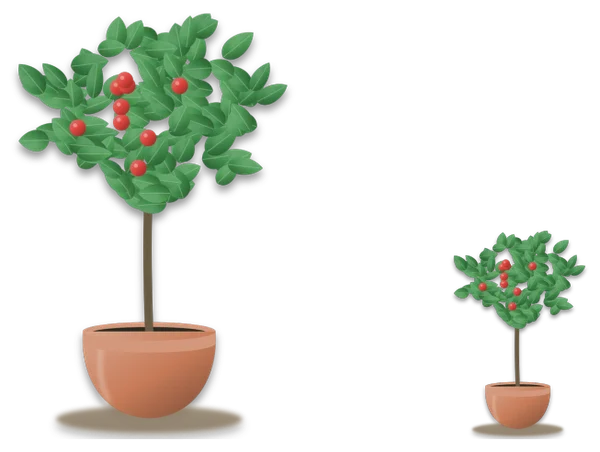
Almost every fruit tree sold today, apple especially, is not growing on its own roots: the fruiting variety is grafted onto a separate rootstock that controls the tree’s eventual size, vigour and how soon it starts fruiting, largely independent of which fruiting variety sits on top of it. A dwarfing rootstock produces a small tree that fruits within a couple of years and stays manageable enough to prune, net and pick without a ladder; a vigorous rootstock produces a considerably larger tree that takes longer to start fruiting but needs less overall attention once established and copes better with poor or dry soil. The fruit itself, its flavour, size and quality, is essentially the same regardless of which rootstock carries it, since that is determined by the grafted variety rather than the roots beneath it.
This matters directly for a small garden: choosing a genuinely dwarfing rootstock, and training the tree as a cordon or espalier flat against a wall or fence, or growing it in a large container, fits a productive fruit tree into a space a full-sized tree could never work in, without giving up anything in the quality of the fruit itself.
Pollination is a separate question entirely
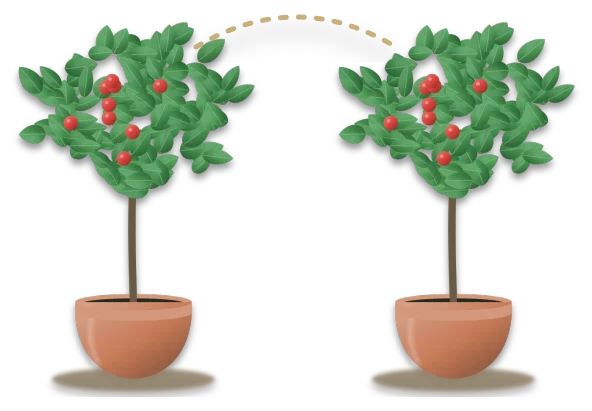
Whether a tree needs another tree nearby to set fruit is a question of pollination group, not size. Some varieties are genuinely self-fertile, setting a full crop entirely alone with no other tree required. Others need a second, compatible variety flowering at the same time nearby, since their own flowers cannot fertilise each other, and planting one alone produces blossom and no fruit at all, however well the tree is otherwise growing. A self-fertile label answers this question specifically, and answers nothing at all about the tree’s eventual size, which is why checking both the rootstock and the pollination group separately, rather than assuming one description covers both, avoids ending up with either an oversized tree or one that never fruits for want of a partner.
Even a self-fertile variety commonly crops more heavily with a compatible pollinator nearby than it would completely alone, since cross-pollination between two compatible trees is generally more effective than a single tree pollinating itself. Where space allows for only one tree, a genuinely self-fertile variety is the safer choice; where space allows for two, choosing a compatible pair, even if one is technically self-fertile alone, is likely to produce a better crop from both.
Citrus and soft fruit follow different rules again
Lemon and other citrus are commonly self-fertile and do not carry the same partner-tree consideration apple and many other tree fruits do, which is one of the reasons a single citrus in a large pot is a realistic proposition even in a small garden or on a patio, without needing a second tree anywhere nearby. Soft fruit such as blackcurrant is different again: grown as a multi-stemmed bush rather than a grafted tree on a chosen rootstock, its eventual size is controlled by pruning rather than rootstock choice, and it is self-fertile in the ordinary garden varieties, needing no partner at all. Checking which category a given fruit actually falls into, tree fruit with a rootstock-and-pollination-group system, or bush fruit without one, avoids applying an apple’s rules to a currant bush or a citrus tree where they do not actually apply.
Choosing for a specific space
Working backward from the available space is more useful than working forward from a favourite variety. A wall or fence run of a few metres suits a trained cordon or espalier on a dwarfing rootstock, and several different varieties can be trained along the same run in the space a single free-standing tree would otherwise take, which conveniently solves the pollination-partner question at the same time by planting compatible varieties side by side deliberately. A large container on a patio suits a tree on the most dwarfing rootstock available, chosen specifically for the confined root run a container represents rather than for its ultimate size in open ground, since even a nominally dwarf tree can outgrow a container faster than the same tree would in the ground. An open bed with room to spare allows a more vigorous rootstock and a free-standing shape, trading a longer wait for the first fruit against a tree that is otherwise lower-maintenance once it is established and cropping.
Reading a rootstock code
Apple rootstocks in particular are commonly sold under a short code, M27 or M9 for the most dwarfing options, up to MM106 or M25 for considerably more vigorous ones, and knowing roughly where a given code sits on that scale is worth more at the point of buying than the code itself might suggest, since the same fruiting variety can be bought grafted onto several different rootstocks and will behave very differently in eventual size depending which one it came on. A nursery or garden centre selling grafted fruit trees should be able to state the rootstock a given tree is on directly, and it is worth asking specifically rather than assuming a tree labelled only by its fruiting variety, “an eating apple” or a named cultivar with no rootstock mentioned, is necessarily suited to the space intended for it. Pear, plum and cherry are each grafted onto their own separate family of rootstocks rather than sharing apple’s naming scheme, so a dwarfing code learned for one fruit does not transfer directly to another, and the same question, what rootstock is this actually on, is worth asking again for each different type of fruit tree under consideration rather than assumed to carry over.
Staking a dwarf tree
A tree on a genuinely dwarfing rootstock typically needs a permanent stake for its entire life rather than only while young, since the rootstock that keeps it small also gives it a smaller, less anchoring root system than a vigorous tree develops, and a mature dwarf tree can blow over in a strong wind without one. This is worth planning for at planting time, driving the stake in before the tree goes in rather than afterward, when it risks damaging roots that are already in place, and checking the tie periodically as the trunk thickens so it does not constrict the bark over the following years.
Planting and the first few years
Whatever the rootstock and pollination group, a new fruit tree establishes best planted in the dormant season with well-prepared soil and a decent mulch, the same principle covered for hedging in this content wave: the mulch calculator works out the quantity a planting hole and its surrounding area actually need. Expect a genuinely dwarfing rootstock to begin fruiting within two to three years, and a more vigorous one considerably longer, which is worth factoring into the size-versus-patience trade-off at the point of choosing rather than discovering only once the tree is already several years into growing.