A lawn through the year
About 12 minutes to read. Published . By the House & Hedge team.
A lawn asks for the same handful of jobs every year, in the same order, and almost all of the frustration people have with lawns comes from doing one of them at the wrong time rather than doing the wrong thing entirely. This is that order, written so it works whichever hemisphere the calendar actually falls in, since a lawn care guide written for one hemisphere and offset by six months for the other gets the fine detail of frost and soil temperature wrong more often than it gets it right.
Early spring: waking it up
The first job is the first cut, done once growth has genuinely resumed and the ground is no longer waterlogged or frozen, rather than on a fixed date. Cut higher than the summer height for this first pass and lower it gradually over the following few cuts rather than scalping a shaggy winter lawn straight back to a tight summer cut, which stresses the grass more than a gradual reduction does. This is also the point to apply the first feed of the year, a balanced or slightly nitrogen-led product to support the leaf growth the lawn is about to put on, and to walk the whole area checking for the winter’s damage: compacted paths worn by foot traffic, patches of moss that built up in the low light and wet of the cold months, and any bare or thin areas worth noting for later attention. This first spring walk-round is also a sensible point to check the borders the lawn edges: roses want their own first feed at bud break, and a hedge of box or laurustinus bordering the lawn is worth its own look for winter damage at the same time, since a single walk around the garden covers both jobs.
In the northern hemisphere this typically falls across March and April; south of the equator, the same point in the season falls across September and October.
Late spring into early summer: settling into rhythm
Mowing becomes routine from here, roughly weekly as growth speeds up, and this is the best window for a first light scarify if moss or thatch built up over winter, since the grass is growing strongly enough to recover from the disturbance quickly. It is also the natural point for a first weed check: an early, targeted treatment on a lawn that is otherwise thickening up nicely deals with a few weeds far more easily than waiting until they have spread across a quarter of the area by midsummer.
Summer: restraint rather than effort
Summer is the season to do less, not more. Raise the mowing height rather than lowering it in hot, dry weather: longer grass shades its own roots and the soil beneath it, and copes with heat and drought stress considerably better than a lawn kept scalped short through summer. A lawn that browns off in a dry spell is very often dormant rather than dead, and the grass beneath the surface is usually still alive and will green up again within a couple of weeks of the next proper rain, so resist the urge to panic-water little and often, which encourages roots to stay shallow, chasing the moisture at the surface. Where watering is genuinely needed, a deep, infrequent soak does more good than a light daily sprinkle that never reaches the root zone at all.
Early autumn: the busiest, most useful window
This is where the year’s real structural work happens, and it is worth treating as one connected job rather than several separate ones. Scarify to pull out the thatch and moss that built up over spring and summer, which lets air, water and any feed that follows actually reach the soil instead of sitting in a mat of dead material on the surface. Follow with aeration, spiking or hollow-tining compacted areas so roots can breathe and water can drain rather than pooling. Overseed any thin or bare patches straight afterwards while the ground is freshly opened, which is exactly the sequence the grass seed calculator assumes when it distinguishes a new lawn’s rate from the lower overseeding rate: overseeding into an untouched, unscarified lawn mostly feeds the birds, because the seed never actually reaches soil.
Early autumn is the best window for all of this in a temperate climate, roughly September to November in the northern hemisphere and March to May in the south, because the soil is still warm enough for germination, rainfall tends to be more reliable than in summer, and whatever grows in has time to establish some root before winter slows everything down.
Late autumn: preparing for dormancy
A lower-nitrogen autumn or winter feed, if a lawn is fed at all going into the cold months, supports root strength through winter without pushing the soft leafy growth a high-nitrogen feed would, which is more vulnerable to cold damage and to the fungal diseases that favour damp, still winter conditions. Clear fallen leaves regularly rather than letting them lie: a thick layer smothers the grass beneath it and creates exactly the damp, dark conditions moss prefers, and leaves blown against the base of a border plant such as lavender do the same thing to it that they do to the lawn, encouraging the damp, still conditions it least wants around its crown. Mowing height goes up again as growth slows, and the frequency drops off naturally as the grass does less.
Winter: mostly leaving it alone
Keep off the lawn when it is frosted or waterlogged; walking on frozen grass damages the leaf structure at a cellular level in a way that shows up as blackened, dead-looking footprints once it thaws, and walking on saturated ground compacts it in exactly the way the autumn aeration was meant to fix. Mowing, where it happens at all in winter, is occasional and high, more a tidy than a cut. This is otherwise a genuinely quiet season for lawn care in both hemispheres, and the temptation to intervene is usually better resisted than acted on.
Mowing height, in real numbers
Height matters more than frequency for most of the year. As a rough guide for an ordinary garden lawn of cool-season grass: around 3.5 to 4 cm through spring and autumn, raised to about 5 cm or a little more through summer heat, and left slightly longer again, rarely below 4 cm, for the few occasional winter cuts. The general rule behind all three figures is the same: never remove more than about a third of the leaf blade in a single cut, since taking off more than that in one go stresses the plant and favours weeds and moss over the grass it was trying to protect.
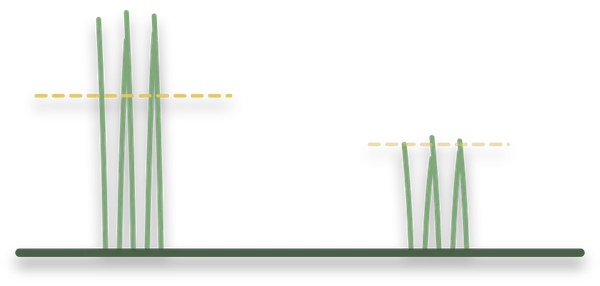
Cool-season and warm-season grass are not the same lawn
Everything above describes a cool-season lawn, the kind common across the UK, most of Europe, the cooler parts of Australia and New Zealand, and South Africa’s higher, cooler regions: it grows most strongly in spring and autumn, slows in summer heat and goes dormant in winter cold. A warm-season lawn, kikuyu and buffalo grass being the common examples across much of South Africa’s summer-rainfall regions and northern Australia, runs the opposite pattern: it grows hardest through summer heat, slows down as temperatures drop, and goes dormant and straw-brown through winter regardless of rainfall, which is normal rather than a sign of a dying lawn. Feeding and the heaviest work for a warm-season lawn move to late spring through summer, and the early-autumn renovation window this guide describes for a cool-season lawn is instead better timed for late spring on a warm-season one, while it is entering its main growing period rather than heading into dormancy. Checking which type of grass is actually growing, rather than assuming, is worth doing before applying any calendar too literally.
The one-line version
Feed and work hardest in spring and autumn, do as little as possible in summer beyond mowing high and watering deep and rarely, and leave it alone in winter. Everything else in this guide is detail on top of that shape.