How to get rid of ants in the house
About 8 minutes to read. Published . By the House & Hedge team.
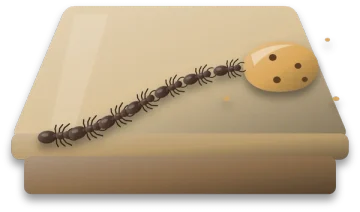
An ant on the counter is one worker out of a colony that may number thousands. Kill that ant and another takes its place, because the trail is still there and the colony is still hungry. That is why sprays tend to disappoint, and why the order of this guide matters. First work out what you have. Then take away what is bringing the ants in. Then, if they keep coming, use bait that the workers carry back to the nest. A professional is the last step, not the first, but there are cases where it should be the first call.
The guide follows the integrated pest management approach that the US EPA describes: identify the pest before you act, prevent first, and move to lower-risk controls before broader ones.
Confirm that they are ants
Two things get mistaken for each other. Ants have a pinched, thin-looking waist, UC IPM says, and termites look broad-waisted. Winged ants have smaller hind wings than front wings and elbowed antennae, which termites do not. Ants often shed their wings soon after swarming, so wings may not be there to check.
Then work out which kind. UC IPM lists the common household species, which vary by region. These are the ones it gives:
- Argentine ant: about 1/8 inch, dull brown, with one node (a bump) on the waist. It eats sweets and sometimes proteins and nests outdoors in shallow mounds. UC IPM calls it the most common ant in and around California homes.
- Odorous house ant: about 1/8 inch, dark brown to shiny black, with one node. It has a strong odor when crushed.
- Pharaoh ant: about 1/16 inch, yellow to orange, with two nodes. It eats fats, proteins and sweets and nests indoors, in wall and cabinet voids.
- Carpenter ant: large, 1/4 to 1/2 inch, black or red and black. It hollows out wood and leaves sawdust-like frass outside its nests.
UC IPM has a key to household ants, with line drawings, that works from the node count, the size and the color.
Follow the trail. A large trail means active foraging. UC IPM says a few stragglers are scouts, searching for food or a nest site. Where the trail enters the house is the most useful thing you can find.
Where they come from
Outdoor colonies nest in soil, often near buildings and sidewalks, and under boards, stones and plants. They may be near trees or shrubs that have honeydew-producing insects on them. They enter for food, water, warmth and shelter, through cracks and along wires and pipes. The sudden arrival of ants is often the weather: a dry spell, a heavy rain, or a drop in outdoor food.
Pharaoh ants nest inside, in wall voids and cabinets. If ants appear in the same room every day and you cannot find a trail from outside, an indoor nest may be the reason.
Start with the gentlest steps
None of these uses a pesticide, and all of them help whatever you do later.
- Wipe the trail. UC IPM says to vacuum trails or wipe them with soapy water or window cleaner, which removes the scent trail. This matters most at entry points.
- Remove food. Store sugar, syrup, honey and pet food in clean, closed containers. Rinse soft drink containers, clean up grease and spills, and take out the trash every day.
- Remove water. Fix leaky faucets and sprinkler heads, because water attracts ants.
- Seal the entry. Caulk cracks and openings around the foundation and other entry points. UC IPM says that in an emergency you can plug openings with petroleum jelly.
- Cut the bridges. Trim branches that touch the house, and keep plants, grass and mulch back from the foundation. UC IPM gives different distances in different places on its page, from several inches to at least a foot, so use the larger.
- Deal with potted plants. UC IPM advises taking infested pots out of the building and soaking them for 20 minutes or more in a solution of 1 to 2 tablespoons of insecticidal soap per quart of water, submerging them until the soil surface is covered.
If the trail is gone in a day or two and does not return, you are finished. If it returns, go on.
If they keep coming: use bait
A bait combines a slow-acting insecticide with an attractant. Workers eat it or carry it back to the nest and share it, and UC IPM says it can kill the whole colony, queens included. The poison has to be slow. A fast one kills the worker before it reaches the nest.
UC IPM’s guidance on choosing and using bait:
- Form. Prepackaged stakes or stations are the safest and easiest for a homeowner. Refillable stations suit a persistent problem. Gels go into cracks where ants enter.
- Active ingredient. UC IPM lists boric acid or borate, fipronil, abamectin and hydramethylnon. The product label names the ingredient. UC IPM says granules containing cyfluthrin or permethrin act as contact insecticides and do not control the colony, and that stations with propoxur or indoxacarb are less effective because they act too quickly.
- Attractant. Argentine ants prefer sweets all year and proteins mostly in spring. Thief and Pharaoh ants prefer protein or greasy baits. UC IPM suggests offering several formulations in one place and seeing which the ants choose.
- Placement. Put baits outdoors near trails, nest openings and the edges of plants. UC IPM suggests stations about 10 to 20 feet apart around the foundation. Use baits indoors only for a serious infestation where you cannot find the way in.
- Maintenance. Check the stations regularly, and refill or replace them when they are empty. Baits dry out or go rancid, and food crumbs near sinks and pantries compete with them.
Expect it to be slow. UC IPM says fewer ants may appear in 5 to 10 days, and that full control may take several weeks.
Why not spray
UC IPM says plainly: do not use any insecticide sprays while you are using baits. A spray kills the foraging workers it touches. It does not reach the colony or the queens, so the ants rebuild. A barrier spray can trap ants indoors, and spraying indoors does not stop more ants coming in. UC IPM adds that pyrethroid sprays such as bifenthrin and cypermethrin pollute waterways, and advises against spraying them outdoors on driveways, sidewalks and foundations.
The EPA adds two cautions of its own: “Use fogging devices only when absolutely necessary,” and “Many chemicals intended for use outdoors are dangerous to use indoors.”
When the bait fails
UC IPM’s list: refill or replace empty stations; move them to where the ants really travel; try a different bait or attractant; keep cleaning the trails and take away competing food; leave out the sprays; and give it several weeks.
When to call a professional
Call one if the infestation is large, if it returns after you have baited and sealed, or if you think the ants are nesting in wood. UC IPM says that for a serious infestation the best option is to hire a pest management professional trained in integrated pest management, and to ask them to use baits and spot treatments rather than perimeter treatments or monthly sprays.
Carpenter ants deserve a close look. Sawdust-like frass pushed out of cracks, or large ants coming out of a wall, point to a nest in wood, and the structure may be at risk. UC IPM says that suspected red imported fire ants should be reported to the county agricultural commissioner. That is advice for California, so outside it ask your state’s extension service or agriculture department.
Safety with baits and sprays
Read the label before you use any product, and follow it. The EPA’s advice is to “always read the label first and follow the directions to the letter, including all precautions and restrictions.”
- Children and pets. The EPA says baits are lower risk when “kept out of the reach of children and pets.” UC IPM says that prepackaged baits are quite safe if kept away from children and pets, advises not putting them where children and pets can reach them, and notes that a station protects the bait from disturbance by children. Hiding stations in mulch outdoors keeps them out of sight.
- After a spray. The EPA says to “remove children, toys and pets from the area and keep them away until the pesticide has dried.”
- Storage. “Store pesticides in their original containers.” The EPA warns that “Children and others have been poisoned by accidentally consuming pesticides stored in food or beverage containers.”
- If someone swallows a bait or a chemical. The EPA’s advice is to “Keep the telephone number of your area Poison Control Center near your telephone: 1-800-222-1222.”
- Pets. If a pet may have eaten a bait or a pesticide, call a vet or an animal poison line at once. The numbers are in the guide on what to do if a pet eats a plant.
Keeping them out
The steps above double as prevention. Keep food closed and surfaces wiped, fix leaks, keep caulk sound, and keep plants and mulch back from the walls. Check the bait stations on a schedule, the same way you would check a smoke alarm. UC IPM names trees with honeydew-producing insects as a food source that draws colonies near a building, so look at shrubs and trees close to the walls as well. For another household pest that comes from the same places, read the guide on cockroaches.