How to get rid of cockroaches
About 9 minutes to read. Published . By the House & Hedge team.
With cockroaches a spray is the wrong first move. UC IPM says sprays may repel and disperse cockroaches to other areas of the building and do not provide long-term control, so the real work is in the order of the steps. Find out which cockroach you have. Take away the food, the water and the cracks they live in. Use bait close to where they hide. And call a professional sooner than you would for ants or flies, because a settled infestation indoors is hard to clear by yourself.
This guide follows UC IPM’s pest note on cockroaches, which is the most complete source, and the US EPA’s safety advice for anything you put down.
Confirm which cockroach it is
UC IPM says plainly that effective management varies with the species. These are the four it describes.
- German cockroach: adult about 0.5 inch, light brown, with two dark stripes behind the head. The female carries a light beige egg case, about 1/4 inch long, until a day or two before it hatches. Each case holds about 30 young.
- Brownbanded cockroach: adult about 0.5 inch, with light bands on the abdomen and wings. Males are golden tan and females darker brown. The female glues light brown egg cases, about 1/4 inch long, to ceilings, under furniture, or in closets.
- Oriental cockroach: adult about 1.25 inches and almost black. Egg cases are dark red-brown, about 3/8 inch long.
- American cockroach: adult about 2 inches, reddish brown, with light-colored edges behind the head. The egg case is about 3/8 inch long and turns from brown to black within a day or two of being laid.
Mix-ups are common. UC IPM says Turkestan females look like Oriental females and that field cockroaches are often mistaken for German ones.
The species matters because of where it lives. German and brownbanded cockroaches live and breed entirely indoors. American, Oriental and Turkestan cockroaches live outdoors and can invade for a while. An outdoor species needs a different answer from a German cockroach, which is the one that takes up residence.
Check with sticky traps and a flashlight
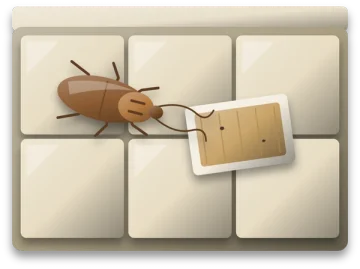
UC IPM says sticky traps or glue boards offer the best way to detect and monitor cockroach populations. Place them where cockroaches travel: where walls meet floors, behind large appliances, and in cabinets. Number each trap so you can track the counts, and check them daily for several days. UC IPM says many times cockroaches are caught in the first 24 hours. Put some traps near exterior doors to see whether outdoor species are coming in.
Then inspect. Use a flashlight, and a small mirror on a long handle if you have one, to look in cracks, under counters, and around water heaters. Look for dark fecal smears, cast skins, egg cases, and live or dead cockroaches.
Where they come from
Cockroaches need food, water and shelter. By day they hide in warm, dark, moist places and they forage at night. UC IPM names cracks, water meter boxes, sewers and crawl spaces. Some routes in:
- From outside. American cockroaches can come in from sewers, especially if pipes are damaged, screens are missing or the water traps in drains are faulty. Oriental cockroaches move indoors at night in search of food, water or mates.
- On things you bring in. Appliances, furniture, boxes and stored goods can carry them.
- Through tiny gaps. UC IPM says an adult German cockroach can hide in a crack 1/16 inch wide. False-bottom cupboards and hollow walls are common refuges.
Start with sanitation and sealing
UC IPM calls good sanitation and exclusion important for effective control. Neither needs a pesticide.
- Close up food. Store food in sealed containers and keep trash in containers with tight lids.
- Fix the water. Fix leaks and moisture problems.
- Clean up. Vacuum cracks and wipe up spills promptly. UC IPM recommends a vacuum with a HEPA filter or triple filters, because shed skins and droppings may cause allergies when inhaled.
- Seal the cracks. Seal cracks and openings, and fit door sweeps and weather stripping. Look for egg cases under furniture and inside appliance motors.
- Look at deliveries. Check food deliveries and boxes before you bring them in.
- Work outside. Trim shrubs, remove dense ground cover and woodpiles near the building, and consider a layer of gravel about 6 to 12 inches wide around the perimeter.
These steps matter for the next stage too. UC IPM says that removing other food sources will greatly enhance the effects of baits.
If they persist: bait
UC IPM says bait products are the primary pesticides used to treat cockroach infestations. They are slow. An effective bait program does not give immediate results, and it may take 7 days or longer.
- Place it close. UC IPM says insecticidal baits do not attract cockroaches over long distances, so put them near where the cockroaches hide. Indoors that means under appliances, along walls, in cabinets, and near fecal specks, which contain an attractant.
- Use stations or gel. Bait stations confine the insecticide to small areas within tamper-resistant containers, which may reduce exposure for people and pets. Gel is applied with a bait gun or syringe in small dabs in the cracks and crevices where cockroaches will find it. Gels may need to be reapplied, because the deposits harden over time.
- Expect brownbanded cockroaches to be difficult. UC IPM calls them especially difficult to control with baits.
Boric acid and dusts
UC IPM says boric acid is not repellent, and if it stays dry and undisturbed it provides control for a very long time, though it may take 7 days or more to have a significant effect. Apply it in thin films in cracks, voids and under appliance kick panels, since thick layers cake and clump. It is not recommended outdoors, because it is toxic to plants. Dusts are for places a child or a pet cannot reach, such as the inside of a wall void. UC IPM also says desiccant dusts, such as diatomaceous earth and silica aerogel, are repellent and effective when applied to voids and other out-of-the-way places. It notes that dust treatment may need a pest control professional.
What not to use
UC IPM advises avoiding foggers, bombs and aerosol sprays, because these products can be hazardous and often fail to reach the places where cockroaches hide. It says sprays may repel and disperse cockroaches to other areas of the building, do not provide long-term control, and that cockroaches have become resistant to many common sprays. It also says pesticides alone will not solve a cockroach problem. The EPA’s safety page agrees about foggers: “Use fogging devices only when absolutely necessary.”
Why it matters for health
UC IPM says indoor infestations are a risk factor for the development of asthma in children, and that allergen levels are directly correlated with cockroach density. German cockroaches are believed to be capable of transmitting disease-causing organisms, and American cockroaches can transmit bacteria that cause food poisoning. That is the reason to treat the problem seriously and the reason for the HEPA vacuum.
When to call a professional
UC IPM says professional pest control services are often required for serious indoor infestations and for large or complex problems. German cockroaches are the most persistent and troublesome species, common especially in multi-unit housing, and severe infestations may spread to other parts of a building.
Call one if:
- you have baited for a few weeks and the trap counts are not falling;
- you cannot find where they are coming from or hiding;
- the infestation is large or the cockroaches are German cockroaches;
- you live in an apartment building where neighbors may have the same problem.
In a rented home or a multi-unit building, tell the building manager. UC IPM says severe infestations may spread to other parts of a building, so treating one unit while its neighbors are infested is unlikely to finish the job.
UC IPM also says indoor chemical control is warranted only if the cockroach population is established, and not for an occasional intruder. An occasional large cockroach may be an outdoor species that has wandered in. Seal the way in and check the drains.
Safety with baits, gels and dusts
Read the label before you use any product, and follow it. The EPA’s advice is to “always read the label first and follow the directions to the letter, including all precautions and restrictions.”
- Children and pets. The EPA says baits are lower risk when “kept out of the reach of children and pets.” Place bait stations and gel where a child or a pet cannot reach.
- After an application. The EPA says to “remove children, toys and pets from the area and keep them away until the pesticide has dried.”
- Storage. “Store pesticides in their original containers.” The EPA warns that “Children and others have been poisoned by accidentally consuming pesticides stored in food or beverage containers.”
- If someone swallows a bait or a chemical. The EPA’s advice is to “Keep the telephone number of your area Poison Control Center near your telephone: 1-800-222-1222.”
- Pets. If a pet may have eaten a bait or a pesticide, call a vet or an animal poison line at once. The numbers are in the guide on what to do if a pet eats a plant.
Keeping them away
Keep food in closed containers, take the trash out every day, and wipe the kitchen at night. Fix every leak. Keep the caulk and weather stripping in good order, and check traps now and then, even when you have not seen a cockroach for a while. For the other pest that comes into kitchens the same way, see the guide to ants in the house, and for flying ones, fruit flies.