How to remove a black water stain from hardwood
About 6 minutes to read. Published . By the House & Hedge team.
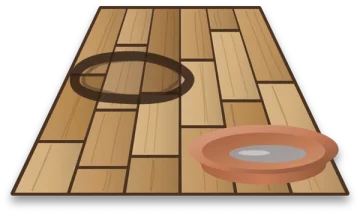
A water mark on a hardwood floor comes in two kinds, and they need different treatment. A surface mark is a white or gray haze on the finish, where water has sat and dried. It often lifts with a gentle clean or a light buffing. A black stain is deeper. It is a dark mark in the wood itself, where water has soaked through the finish, reacted with the natural chemicals in the wood, and darkened the grain. A black stain does not come off with a cloth, and it may need a wood bleach or sanding.
This guide shows how to tell the two apart, how to start with the gentlest method, and when to stop and call a specialist.
Telling the two apart
Look at the mark in good light, and try a few simple tests.
- Wipe the mark gently with a cloth dampened with water and a little mild soap. If the mark lifts, it was on the finish.
- Check whether the mark is still there after the finish has dried. A surface mark usually looks cloudy or milky, and it has a soft edge.
- A black stain looks dark, often with a defined shape, and it stays dark when the surface is wet and dry. It is in the wood grain.
- Press a fingernail gently across the mark. A surface mark may feel slightly rough. A black stain feels smooth, because the finish is intact over the wood.
If the mark lifts with soap and water, the finish is the only thing that was damaged, and you can stop there. If it does not, it is a black stain, and it needs the steps below.
What you need
- Rubber gloves and safety glasses
- A soft cloth, and a fresh one for each stage
- Mild dish soap and warm water
- A cleaner made for your floor’s finish
- Fine abrasive paper, such as 220 grit, for light buffing, if the maker allows it
- A wood bleach made for dark stains, if the stain is still visible after the gentle steps
- Mineral spirits or a wood cleaner, for removing wax or residue, if needed
- A dry cloth for the final wipe
Start with the gentle steps
Work from the gentlest step to the strongest, and stop once the stain has gone.
- Clean the area with a cloth dampened with water and a little mild soap. Dry it completely with a clean cloth.
- Buff the area lightly with a soft cloth and a cleaner made for the finish. This removes the top layer of haze, and it sometimes lifts a surface stain.
- For a surface stain that is still visible, very lightly buff the area with fine abrasive paper, working along the grain. Keep the pressure light, and check the finish after each few passes. Stop as soon as the mark lightens, because sanding the finish removes it permanently. Clean the dust away and apply a fresh coat of the finish the floor needs, as the maker advises.
Do not use steel wool on a finish, because the fine particles can rust, and they leave marks in the wood. Do not use strong solvents on a sealed floor unless the maker says they are safe.
Using a wood bleach on black stains
For a black stain, the most common method is a two-part wood bleach, usually based on oxalic acid. These products lift the dark color out of the wood, and they work well on many water stains. They are strong, though, so follow the label exactly.
- Put on rubber gloves and safety glasses, and open a window or run a fan. Keep children and pets away from the area.
- Test the bleach on a hidden spot, such as inside a cabinet or under a piece of furniture. Check the result after the time on the label, and make sure the wood does not change color more than you want.
- Apply the bleach to the stain with a cloth or a brush, following the label. Work carefully, keeping the bleach on the stain and off the surrounding wood as much as possible.
- Leave it for the time the label gives. Some stains lighten in minutes, and others need several applications.
- Neutralise the bleach as the label directs, usually with a second product or with clean water, so that the wood is not left in an acid state.
- Rinse the area and dry it fully. Check the stain again once the wood is dry, because some stains look darker when wet.
Repeat the bleach if needed, but do not keep applying it past the point where the stain is no longer lifting, because the wood can lighten unevenly. If the surrounding wood has lightened, it may need to be blended with a stain or a sanded and refinished area, and that is a job for a specialist.
When the bleach does not work
A stain that is still dark after careful bleaching has probably gone deep into the wood, or it has reached the fibers at the edge of a board. Sanding can remove it, but only by taking off a layer of wood, and that can change the thickness of the board. On a thin engineered floor, sanding may not be possible at all.
A floor specialist can sand the area and refinish it, and they can often blend the new finish so the repair is invisible. This costs more than a home treatment, but it is the right answer for a deep stain, especially on a valuable floor.
Why the stain happened, and how to stop it
Water stains come from water that sits on the floor, so the most important step is to prevent it happening again.
- Wipe spills at once, including water from plant pots, pet bowls and wet shoes.
- Use felt pads and mats in wet areas, such as at the sink or near the door.
- Check the floor for leaks under sinks, around radiators and near the dishwasher.
- Keep the finish in good condition, and reseal the floor when the maker advises. A worn finish lets water reach the wood.
- If the stain came from a leak, fix the leak first. A stain that keeps coming back is a sign that water is still getting through.
Safety
Wood bleach and the products used with it are corrosive. Wear gloves and eye protection, keep the product away from your skin and out of reach of children and pets, and never mix two products unless the label says it is safe. If the bleach splashes onto skin or into the eyes, rinse with plenty of cold water and seek medical advice.
When to call a professional
Call a floor specialist if the stain is large, if it covers several boards, if the boards are cupped, swollen or lifting at the edges, or if the wood looks rotten or soft. Those are signs of a serious water problem, and the subfloor may be damaged too. A specialist can check the floor for hidden moisture, repair the source of the water, and restore the area properly.