Renovating a tired lawn
About 12 minutes to read. Published . By the House & Hedge team.
Lawn seed calculator
Work out how much grass seed to buy for your lawn.
A lawn that has been mown for years without ever being scarified, aerated or overseeded is not usually beyond saving, even when it looks thin, mossy and tired enough to consider starting over from bare soil. A proper renovation, done as one connected sequence rather than a single isolated job, brings most lawns back without the cost and disruption of stripping the whole thing and starting again.
When renovation is enough, and when it is not
Renovation suits a lawn that is thin, patchy, mossy or compacted but still has a reasonable covering of actual grass across most of its area. A lawn that is genuinely more weed and moss than grass, or bare soil across a large majority of its area, is more efficiently dealt with by stripping back and reseeding from scratch, since renovating a lawn that has almost nothing left to build on spends as much effort as starting over while getting a worse result. Somewhere in between, a lawn roughly half grass and half everything else, is a judgement call, and erring toward renovation first is reasonable, since it is the lower-cost, lower-disruption option to try before committing to a full strip. It is also, conveniently, the same season a border of roses or lavender alongside the lawn wants its own autumn tidy, so a lawn renovation weekend is a sensible one to combine with the wider garden’s own seasonal jobs rather than treat as an isolated task.
Step one: scarify
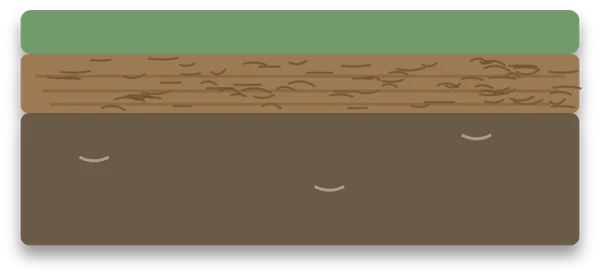
Scarifying rakes out thatch, the layer of dead grass, moss and organic debris that builds up at the base of the sward and, once it gets thick, blocks water, feed and air from reaching the soil and the roots beneath it. A spring-tine rake for a small area or a powered scarifier for anything larger pulls this material out, and the lawn will look considerably worse immediately afterwards, thinner and more bare than before, which is normal and expected rather than a sign anything has gone wrong. This is also the point to remove as much moss as the scarifying pulls out; treating live moss with an appropriate product beforehand, so it is dead rather than live when scarified, stops fragments from simply re-establishing elsewhere on the lawn.
Step two: aerate
Aerating relieves the compaction that has built up under years of foot traffic and mowing, opening channels for air and water to reach the root zone. A solid-tine fork, pushed in and rocked at regular intervals across the lawn, suits most garden lawns with moderate compaction; a hollow-tine aerator, which removes a small core of soil rather than just making a hole, is the better choice for genuinely compacted ground, since it actually removes material rather than just displacing it sideways, which on badly compacted clay can make the compaction worse immediately around the hole. Whichever tool is used, this step matters more on heavy clay and high-traffic lawns than on light, free-draining soil that rarely compacts in the first place.
Step three: overseed
With the surface opened up by scarifying and aerating, seed sown now actually reaches soil rather than sitting on top of thatch, which is the entire reason the order matters. The standard overseeding rate is lower than a new lawn’s rate, since existing grass is filling most of the space already, and sowing at the new-lawn rate onto an existing lawn wastes seed the ground has no room for. Choose a seed mix suited to the lawn’s actual use, hard-wearing for anything used heavily, shade-tolerant for anything under trees, rather than a generic mix that may not suit the specific conditions.
Step four: top-dress
A thin layer of sandy topdressing compost, worked into the surface with the back of a rake or a broom rather than left sitting on top, firms the new seed into good contact with the soil, helps level any minor dips the scarifying and aerating revealed, and gives young roots an easier, looser medium to establish into than the existing compacted soil alone would. This step is optional on a lawn in reasonably good underlying condition but genuinely useful on anything uneven or on heavier soil.
How the calculator works
The lawn seed calculator works out how much grass seed to buy. Enter the length and width of the lawn in metres and choose a new lawn or overseeding. It gives the seed in grams and kilograms.
The sum is: area = length x width in square metres, and seed = area x rate. The rates are 35 grams a square metre for a new lawn on bare soil and 25 grams for overseeding. With the defaults, a lawn of 10 m by 8 m is 80 square metres. Overseeding at 25 grams is 2000 grams, or 2 kg, where a new lawn at 35 grams would need 2800 grams.
The rates differ because of what is already in the ground. Overseeding goes into a lawn where the existing grass fills most of the space, so its rate is lower than a new lawn’s, and the guide warns that sowing at the new-lawn rate onto an existing lawn wastes seed the ground has no room for. The order of work matters too. After scarifying and aerating, seed reaches soil rather than sitting on top of thatch.
These are typical rates. The packet knows better, so if it gives a different rate, work from the packet. The calculator treats the lawn as one rectangle. For an odd shape, work out each rectangle and add the seed together. Choose a seed mix to suit the use, hard-wearing for heavy use and shade-tolerant for a lawn under trees.
Feeding and watering afterwards
A light autumn feed, or a starter feed formulated for new grass if one is available, supports the new seedlings without pushing the kind of soft growth a high-nitrogen summer feed would encourage. Keep the whole area consistently damp, not waterlogged, until the new grass is established, which typically takes one to three weeks depending on temperature and the seed mix used; a dry week at the wrong moment during germination undoes a large part of the preceding work.
Timing the whole sequence
Early autumn is the best window for a full renovation in most temperate climates, roughly September to November in the northern hemisphere and March to May in the south, since the soil holds enough warmth for the new seed to germinate reliably while rainfall tends to be more consistent than in summer, and whatever germinates has time to build some root before winter slows growth down. Spring is the second-best window where autumn is missed, though a spring renovation competes more with weed germination and needs closer attention to watering through the following summer.
Equipment: hire rather than buy, for most gardens
A powered scarifier and a hollow-tine aerator are both machines worth hiring for a weekend rather than owning outright, unless a lawn is large enough or troublesome enough to need one every single year. Most equipment hire outlets carry both, and doing the scarifying and aerating passes back to back over the same rented weekend is the efficient way to use the hire cost, since both jobs are wanted at the same point in the sequence anyway. A smaller garden lawn can reasonably be scarified with a spring-tine hand rake and aerated with a garden fork, slower but entirely workable, and often the more proportionate choice for anything under about a hundred square metres, or for a lawn edged closely by a hedge of box or laurustinus where a powered machine has little room to manoeuvre without catching the hedge itself.
What a successful renovation actually looks like a year later
A renovation that has genuinely worked shows up less as a single dramatic before-and-after and more as a lawn that simply behaves better through the following year: it browns off less readily in a dry spell because the roots can now reach further into aerated soil, it carries noticeably less moss the following winter because drainage and light reach it better, and it shrugs off ordinary foot traffic without wearing bare in the same spots as before. Judging the renovation only by how the lawn looks in the first few weeks, while the new seed is still thin and the scars of the scarifying are still visible, undersells work whose real payoff shows up over the following twelve months rather than immediately.
Patience through the first season
Keep foot traffic off a newly renovated lawn as much as practically possible while it establishes, and hold off on the first cut until the new grass has reached a reasonable height, then take off no more than the top third in that first pass. A renovated lawn typically looks reasonable within a few weeks but takes a full growing season, and sometimes longer for a lawn that was badly worn beforehand, to reach the density a well-established lawn holds. Expecting an instant transformation is the most common reason people judge a renovation to have failed when it has, in fact, simply not finished yet. A second, lighter pass the following autumn, repeating the sequence at a smaller scale on whatever areas are still thin, finishes what the first full renovation started and is a normal part of the process rather than a sign the first attempt went wrong.