Dish soap on houseplants, and when to leave it alone
About 7 minutes to read. Published . By the House & Hedge team.
Soap spray mixer
Work out how much washing-up liquid to add to your water for a gentle one or two percent spray.
The amount of water in your spray bottle.
The guide says less is better for delicate leaves.
Washing-up liquid is one of the most common home remedies for houseplant pests, and it works within limits. A soap spray breaks down the protective outer layer of soft-bodied insects, such as aphids and mealybugs, and they dry out and die. Spider mites can be knocked back too. The trouble is that the same soap that works on pests can also strip the waxy coating of a leaf and scorch it. A bottle of plain kitchen soap is also not the same product as a labeled plant spray, and the difference matters.
This guide explains how to make a gentle spray, which pests respond to it, which plants need extra care, and how to test before you treat the whole plant.
What soap does, and what it does not
Soap works on contact. It dissolves the waxy layer on the body of a soft-bodied insect, and the insect dehydrates. It does nothing to eggs tucked under a leaf, and little to larvae hidden in the soil. It also does not last. Once the spray dries, it has done its work on whatever it touched, so the treatment has to be repeated to catch the pests that hatch later.
Aphids, mealybugs, whitefly and spider mites respond to soap, though heavy infestations of whitefly may need more than one approach. Scale insects that have settled and formed a hard shell are much less affected, and they need a different treatment, which the guide on hard spots covers.
Aphids and honeydew
Aphids are small, soft, pear-shaped insects that cluster on new growth and on the undersides of leaves. They feed on sap and give off a sticky, sugary liquid called honeydew, which coats the leaves beneath them. Honeydew is a sign of aphids, and it draws sooty mold, so a sticky leaf is often the first thing a grower notices.
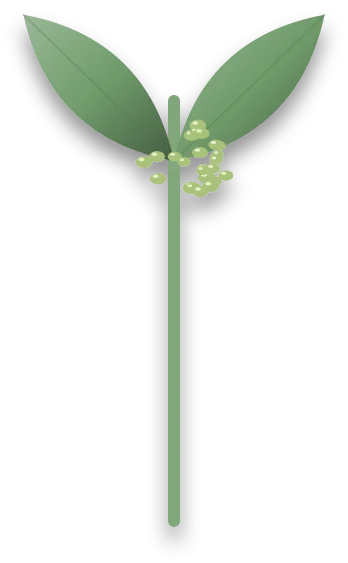
A soap spray breaks the surface of the aphid and dries it out, so aim the spray at the clusters on new growth and at the undersides of the leaves, where the aphids feed. Wipe the honeydew off afterward, because it attracts mold and makes the leaves dusty. Keep checking the new growth, since aphids can return from neighbouring plants.
Making the spray
Use one to two teaspoons of plain washing-up liquid in half a litre of water, which is about a pint. Stir gently rather than shaking, so the mix does not foam over. Pour it into a clean spray bottle, and label the bottle with the strength and the date. Unlabeled bottles get used on the wrong plants, and a mix made weeks ago may not be the strength you think it is.
Make a fresh batch each time you treat the plants. Keeping the mix for weeks invites bacteria, and it makes the strength harder to control from one treatment to the next.
How the calculator works
The soap spray mixer works out how much washing-up liquid to add to the water in your spray bottle. Enter the water in litres, choose a strength of 1 or 2 percent, and it gives the soap in millilitres and in teaspoons.
The sum is: soap in ml = water in litres x 1000 x strength / 100, and a teaspoon is 5 ml. With the default of half a litre at 1 percent, the water is 500 ml, 1 percent of 500 is 5 ml of soap, and that is one teaspoon. At 2 percent the same bottle takes 10 ml, which is two teaspoons. That matches the guide’s rule of one to two teaspoons in half a litre.
The strength is capped because of how soap works. It dissolves the waxy layer on the body of a soft-bodied insect, and the insect dries out. A leaf has a waxy coating too, and a stronger mix strips it and scorches the leaf. The guide says less is better for delicate leaves, so start at 1 percent and test one leaf first.
The percentage is taken from the water, and the soap adds so little volume at these strengths that it makes no practical difference. The answer assumes plain washing-up liquid with no bleach, degreaser, antibacterial agent or fragrance, and a level 5 ml teaspoon, not a cutlery spoon. It cannot tell you whether your plant tolerates soap, which is what the one-leaf test is for. Make a fresh batch each time, as the guide advises, and stir gently rather than shaking.
Which soap to use
Use a plain washing-up liquid with no bleach, no degreaser, no antibacterial agent and no added fragrance. Read the label, and check the ingredients for anything that is not soap and water. A potassium-based soap made for plants is gentler on leaves, and it is worth buying if you treat plants often. A labeled insecticidal soap is safer still when you are not sure about the kitchen product.
Do not use a soap that contains moisturizers, oils or silicone. These coat the leaves and can block the tiny pores the plant uses to breathe, and they can make the leaves look shiny and dusty at the same time.
Spider mites and webbing
Spider mites are tiny, often too small to see, and they live on the undersides of leaves. The first sign is usually a pale, speckled look on the leaves. When the infestation is heavy, fine silky webbing appears between the leaves. In hot, dry rooms they multiply quickly, so check the plant every few days in summer.
Soap works on spider mites, but the eggs hatch within about a week, so repeated sprays are essential. Spray the undersides of the leaves thoroughly, and rinse the leaves once the spray has had time to work. Raising the humidity around the plant can slow the mites as well. Stand the pot on a tray of wet pebbles, with the pot sitting above the water, or group plants together.
Test first
Before you spray a whole plant, test one leaf, or a small part of one, with the mix. Leave it for twenty-four to forty-eight hours in the room where the plant lives. If the test area browns, yellows, becomes spotted or looks glossy in a way that is not normal, dilute the mix further or stop. Some plants react badly even to a weak mix, and a test costs one leaf while a failed treatment can cost the whole plant.
Test on a mature leaf rather than a new one, because new leaves are more delicate and react more strongly.
Plants that need extra care
Some plants are sensitive, and soap can scorch them. Waxy and hairy leaves can be damaged, and so can fine, feathery foliage. Ferns and young, soft-leaved plants often react badly to soap. A plant that is stressed by heat, drought or low light is much more likely to scorch, so do not spray a struggling plant in strong sun. If you are not sure whether a plant is sensitive, test it first, and then decide.
Monsteras, philodendrons, dieffenbachias and aloe are common houseplants that are often treated with a weak soap spray, but each plant varies, and a test on one leaf is still the right first step.
How to spray
Spray the whole plant, with close attention to the undersides of the leaves, the leaf joints and the stems, because pests hide in those places. Spray until the leaves are wet but not dripping heavily. Work in the shade, or in the early morning or evening, so the spray does not dry in the sun and scorch the leaves.
Leave the spray on for about an hour, or for as long as your test allowed, then rinse the plant with clean water. Rinsing removes the soap and reduces the chance of a residue building up on the leaves. Wipe off any sticky film with a damp cloth.
Repeat the treatment
Repeat the spray every five to seven days for about three weeks. That schedule catches the pests that hatch after the first treatment. Stopping early is the usual reason a soap treatment fails. The pests look gone, but the eggs are still there, and the next generation arrives within days.
Check the plant before each repeat, and note the date of each spray in the daily log. If the pests come back in large numbers, or the plant keeps getting new infestations, the source may be in the soil, in the pot, or in a new plant that brought the pests home.
Look for the source
Pests spread from plant to plant, so inspect the rest of the collection while you treat the one that is affected. Quarantine a new or heavily infested plant for several weeks, away from the others. Wipe the leaves of neighbouring plants, and check the saucers and the shelf nearby. Clean the rim of the pot and the saucer, because pests can live in the debris that collects there.
Fungus gnats, which are small flies that breed in damp compost, are a soil problem, and a leaf spray will not reach their larvae. If you see tiny flies rising from the pot when you water, treat the compost instead.
When soap is not enough
Soap is a first step, not a cure for every problem. Scale insects, which form hard brown or white bumps on stems and leaves, are not controlled well by soap, and they need scraping and sometimes a different product. Whitefly on a heavy infestation may need more than a soap treatment. A badly affected plant that is valuable to you may justify asking a garden centre for a product labeled for the specific pest.
Work through the symptoms in the diagnoser first. If the plant keeps losing leaves, or if the pests return after several weeks of careful treatment, take a photograph of the leaves, both the top and the underside, and ask a garden centre or a plant health service to look at it.
Safety
Wash your hands after you handle the spray. Keep the mix away from children and pets, and store it out of reach. Do not add other chemicals to the spray, because mixing products can produce irritating or harmful results. Keep the spray off ponds and fish, because soap can harm them. If you spray edible plants, stop using the mix close to harvest, and wash the crop before eating it.