Hard spots on houseplants, and how to tell scale from mineral crust
About 7 minutes to read. Published . By the House & Hedge team.
Hard spots on a houseplant are one of the most misdiagnosed problems. A brown bump on a stem might be a pest. A white crust on the soil might be a mineral deposit left by tap water. A pale spot on a leaf might be a fungal infection, or a scorch from the window. Each has a different fix, and treating the wrong one wastes time and can harm the plant.
This guide helps you tell the common causes apart and shows what to do for each. The most important pair to separate is scale insects and mineral crust, because both look hard and both appear on the same plants.
Scale: small bumps that are alive
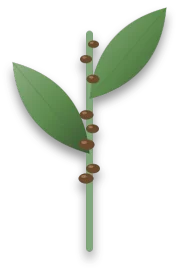
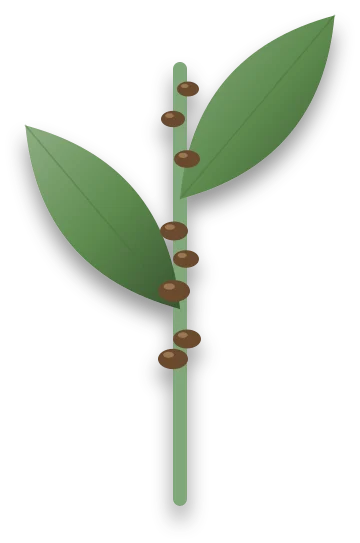
Scale insects are sap-sucking pests. Many species form a hard, waxy shell over their bodies, while others form a softer covering. Either way they stay fixed in one place. They look like small brown, gray or white bumps on the stems, the undersides of the leaves and the leaf joints. Some are flat and oval, and some are round. Hoyas, citrus plants, ferns and some palms are among the houseplants where they are commonly seen.
Scale is not a dust. It is a living insect that feeds on the plant’s sap. Over time it weakens the plant, causes yellowing, and leaves a sticky honeydew. The honeydew attracts sooty mold, which is black and powdery and shows the pest is there rather than being a problem in its own right.
Mineral crust: white, and on the surface
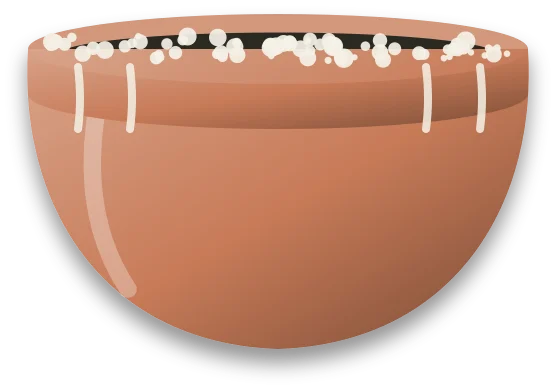
Mineral crust is a deposit left by water. Tap water contains dissolved salts, and when the water evaporates, the salts remain as a white, chalky crust on the soil surface, on the rim of the pot, on terracotta, and sometimes on the leaves. Fertilizer salts add to the build-up. The crust sits on top of the surface and does not grow.
Mineral crust is not alive, and it does not feed on the plant. It is unsightly, and a heavy build-up can make it harder for water to soak into the compost. It is worth clearing, but it is not a pest.
Brown or black spots on leaves: a different problem
Brown or black spots on leaves, often with a yellow edge or a darker ring, are usually fungal or bacterial leaf spots. They tend to come from water that splashes onto the leaves and stays there, or from still, damp air. They are part of the leaf rather than something sitting on top of it. A scale insect can be scraped away, but a leaf spot cannot, and it will stay until the leaf is removed.
Pale or white powder on the leaves that wipes off with a finger, leaving green leaf underneath, is powdery mildew. Soft white fluff in the leaf joints is usually mealybug, which feeds in a different way and wipes off more easily than scale.
Soft white fluff: mealybug
Mealybugs are soft, slow-moving insects that cover themselves in a white, woolly wax. They gather in the leaf joints, along the stems and under the leaves, and they suck sap from the plant. Unlike scale, they are soft, and they do move, though slowly. A cotton swab dipped in 70 percent isopropyl alcohol removes them on contact, after the usual test on one leaf.
Powdery coating: mildew
Powdery mildew is a fungus that coats the leaves in a fine white dust. The coating wipes off with a finger, but it comes back, and the leaf underneath can turn yellow or pale. It spreads most in still, humid air, and it is common on crowded plants kept too warm.
How to tell them apart
Use these checks.
- Does it wipe off with a damp cloth? If yes, it is probably mineral crust or dust.
- Does it scrape off with a fingernail and leave a smear or a soft, moist spot? If yes, it is probably a live scale insect.
- Does it lift off as a dry flake with nothing soft underneath? That is usually a dead scale insect or an old shell, which needs removing but no treatment.
- Is it a spot on the leaf surface, with a yellow halo and a sharp edge? That points to a leaf spot.
- Is it a soft, fluffy white covering in the leaf joints? That is mealybug, and it is a different pest.
- Is it a powdery coating that wipes off with a finger, leaving green leaf below? That is powdery mildew.
Treating scale
Scrape the scale gently, using a soft plastic tool, a fingernail or a cotton swab dipped in 70 percent isopropyl alcohol. Test the alcohol on one leaf first, because some leaves are sensitive. Avoid metal blades, which cut the tissue and let infection in.
Check the whole plant, including the undersides, the joints and the stems. Scale hides well, and a few missed insects will start a new colony. Repeat the check every week for about a month.
Where scale covers a stem, remove the stem if the plant can spare it. A heavily infested stem will keep producing pests, and removing it is often quicker than treating every insect on it. For a heavy infestation across the whole plant, a labeled product for scale may be needed. Follow the label exactly, and keep the plant out of direct sun while the treatment dries.
Treating mineral crust
Wipe the crust off the pot rim and the soil surface with a damp cloth or a small brush. For a stubborn crust on a terracotta pot, soak the pot in equal parts white vinegar and water for about thirty minutes, then scrub and rinse it well. If the crust is heavy on the compost, scrape off the top layer and replace it with fresh compost.
Flush the soil by watering it thoroughly from above, letting the water run through the drainage holes, and emptying the saucer afterward. Repeat every few months. Rainwater or filtered water helps, and so does applying less liquid fertilizer. Water that is heavy with salts is the main source of the crust.
Treating leaf spots
Remove the affected leaves with clean secateurs, and put them in the bin rather than on the compost heap, so the fungus does not spread. Water the plant at the soil level rather than over the leaves. Improve the air movement around the plant, and keep the leaves dry where you can. A leaf spot rarely kills a healthy plant on its own, but it spreads in damp, still conditions.
Treating powdery mildew
Improve the air movement around the plant and reduce humidity where you can. Wipe the leaves with a damp cloth, and remove the leaves that are heavily affected. A fungicide labeled for powdery mildew is sometimes needed, but most houseplant mildew responds to better airflow and less crowding, so start there.
Preventing scale and mineral crust
Check every new plant, such as a monstera or a philodendron, before it joins the collection. Look at the undersides of the leaves, the leaf joints and the stems, and quarantine anything with bumps for a few weeks. Scale spreads slowly, but it can arrive on a single plant, and a quarantine keeps it from reaching the rest.
Water with rainwater or filtered water where you can, and let the top of the compost dry a little between waterings. Mineral crust builds up fastest where the water is hard and the pot stands in water. Flush the soil every few months, and feed at half strength, because surplus salts add to the crust. A wipe of the leaves with a damp cloth once a month removes dust and early scale before they spread.
When to ask for help
Start with the diagnoser. If the spots spread quickly, if new growth is deformed, or if the plant is losing leaves faster than it can produce them, ask a garden centre or a plant health service to look at it. A photograph of the affected leaves, with a close-up of the underside, helps them give a useful answer. Bring a sample in a sealed bag if you can, because some problems are easier to identify in person.