Ferns in a windowless bathroom
About 6 minutes to read. Published . By the House & Hedge team.
Most bathrooms have no window, and a fern in one has a problem that humidity cannot solve. The fern entries on this site rate humidity as high for the species covered here, which is why bathrooms are tempting. But damp air is not light. A fern makes its food from light, and a windowless room supplies none unless you add it. This guide sorts out which ferns tolerate a dim room, how far a lamp should sit above the fronds, and the signs that a fern is getting too little.
The sun does not matter here. A windowless room gets no sunlight whichever way the house faces, so the questions are about the lamp and the fern rather than the compass.
In a room with a window, a lamp is a supplement that fills in the gaps. In a windowless room it is the whole supply of light, so the hours and the distance matter far more, and a day with the lamp switched off is a day with no light at all.
What ferns need from light
The University of Florida IFAS publication on the Boston fern describes the plant as growing in part shade or part sun, and in the shade, and it says the plant grows in partial to deep shade. Deep shade is still light. It is a dim corner of a bright room, not a room with the lights off.
The Boston fern entry on this site says it wants bright indirect light with no direct sun, and that it thins out if the room is genuinely dark. That is the line the rest of this guide turns on. A windowless bathroom is genuinely dark until you add a lamp.
Why a windowless room is harder than a dim one
A dim room with a window still gets some daylight, even if it only reaches the back of the room near the glass. A windowless bathroom gets none. The entries that tolerate a dim room describe tolerance of reduced light, not darkness, so that tolerance does not carry over unless a lamp supplies the light. Plan the lamp first, and choose the fern second.
Choose the fern for the room
Not every fern is equally forgiving of a dim room. The site’s entries give a useful spread. The bird’s nest fern is the only one of these four listed at low light, and its entry describes low to medium indirect light, the light it gets on a tree trunk under a canopy. The ribbon fern takes less light than most ferns and no direct sun at all, which makes it a strong choice for a bathroom with a lamp. The maidenhair fern wants medium light or shade, and its entry warns that an hour of direct sun will crisp the whole plant. The Boston fern needs the most light of the four, so it is the one that most needs a good lamp.
Choose by the lamp you can run, not the bathroom you wish you had. If the lamp is weak or the hours are short, the bird’s nest fern or the ribbon fern is the safer bet.
Set the lamp
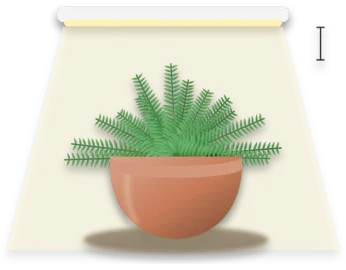
Iowa State University Extension gives the most usable figures for a windowless room. For fluorescent fixtures, it advises placing the light within 4 to 6 inches of the tops of the plants and leaving the lights on for 12 to 14 hours each day. Illinois Extension gives a similar height, about six inches above the plants, but suggests 14 to 16 hours. The hour ranges overlap, so start with the Iowa State range, watch the fern for a few weeks, and only then change the hours.
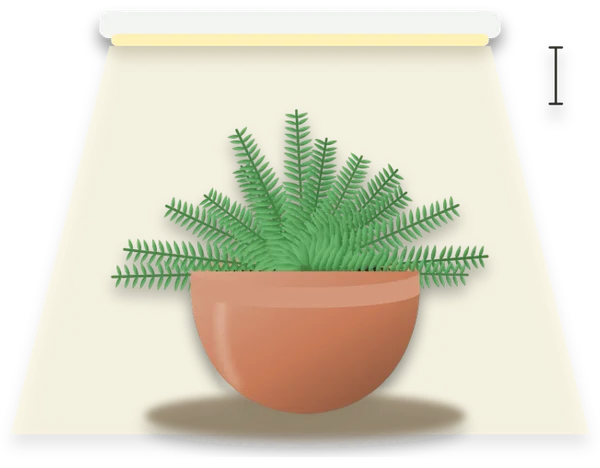
A timer keeps the hours the same every day, which is easier than remembering the switch. Set it once, check the fern every week or two, and change the timer rather than the habit if the plant looks wrong.
Are plant lights worth buying?
Iowa State University Extension calls plant lights an excellent light source for houseplants, and then says they are expensive and generally not worth the additional cost. For one fern in a bathroom, an ordinary fluorescent fixture placed at the right height is the sensible starting point. LED fixtures are a different case, because their useful distance depends on the fixture, so use the maker’s figure for those.
What a light-starved fern looks like
Illinois Extension says a plant tells you when it is not getting enough light, because its stems become thin and it leans toward the light. In a fern, that shows as thin stems that bend toward the nearest light source, and fronds that reach sideways rather than standing up in the pot. Those are signs to move the lamp closer, or to lengthen the hours, before the plant declines further.
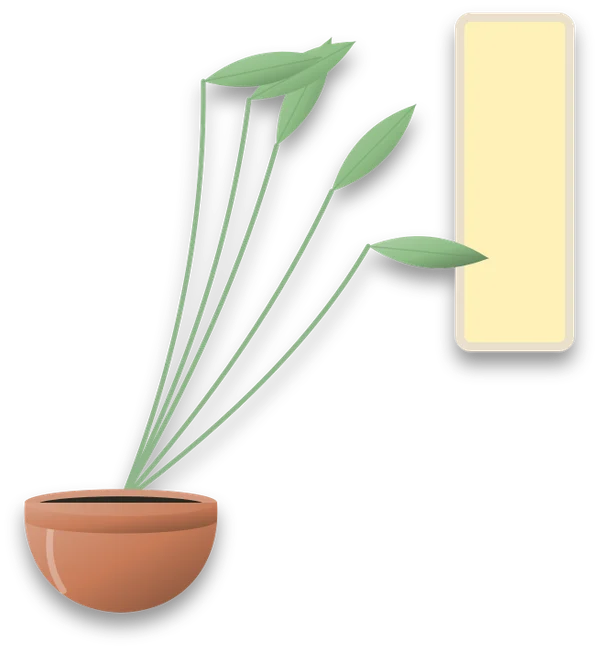
Turning the pot now and then spreads the lean, so the plant grows more evenly. Check the gap between the lamp and the fronds as well as the hours, because the height is the other half of the setting.
Keep the compost right
A bathroom is humid, but humid air is not the same as damp compost. Test the compost with a finger before watering, as you would for any houseplant, and water only when it needs it. The Boston fern entry says to keep the compost lightly moist at all times, and never let it dry out completely or sit in water. The bird’s nest fern entry adds a warning about the centre of the plant: water around the edge of the pot, because water poured into the nest rots it.
Those rules are the same as in a bright room. What changes in a windowless bathroom is the light, not the watering.
The maidenhair fern entry offers one method for a surface that has dried out: stand the pot in water for twenty minutes, then pour away what is left. Treat it as a rescue for a dry surface rather than a weekly routine.
When the room is too dark for a fern
If you cannot run a lamp, a fern is the wrong plant for the room. The UF/IFAS interiorscape guide for the ZZ plant says the ZZ is more tolerant of low light than snake plant and other foliage plants, which makes it a better choice for a dim room. Its own studies found that it can grow and produce new leaves at 25 foot-candles for more than a year. That is a dim room, not a windowless one, so even the ZZ is not a plant for total darkness. For a shut cupboard with no light at all, the guide on a houseplant in a dark cupboard covers what is known and what is not.
Where to go next
Measure the light you have before you buy anything. The guide on light room by room explains how to read light without a meter. If a fern is already struggling, the diagnoser asks what you can see on the plant. If you are choosing a new plant for the room, the plant finder can narrow the list by light.