Taking plants outside for the summer and back in for the winter
About 8 minutes to read. Published . By the House & Hedge team.
A summer outdoors gives most foliage plants more growth than the whole of the rest of the year. It is also the two moves in and out that kill more houseplants than any pest, because a plant is being asked to change everything about its conditions in an afternoon.
Both moves are the same problem in opposite directions, and both have the same answer: do it in stages, and check the plant before it crosses the threshold.
Which plants are worth moving out
Most tropical foliage plants benefit. Rubber plants, monsteras, dracaenas, hoyas, palms and almost every succulent will put on visible growth in a summer outside that they would not manage on a windowsill. Citrus in a pot genuinely wants to go out, and fruits far better for it.
Some are not worth the risk. Anything with thin soft leaves that wind will shred, calatheas and marantas above all, is better left where it is. So is anything you would be upset to lose, because outdoors there are slugs, hail, cats and a forecast that is sometimes wrong.
And some should not go out at all in a cool climate: African violets, most orchids and anything that resents being moved.
Going out: the temperature comes first
The night temperature decides this, not the day. Wait until nights are reliably above about ten degrees, and above twelve for anything genuinely tropical. In the northern temperate world that is late May or June; south of the equator it is October or November. A warm week in April is a trap.
The almanac is built around the same logic for the garden and will tell you what month you are actually in for your hemisphere, which is worth a glance if you have just moved between them.
Going out: two weeks of shade
This is the part that gets skipped and it is the part that matters.
A leaf grown indoors has a thin cuticle and few of the protective pigments a leaf grown in sun develops. Put it in direct sunlight and it burns, in a single afternoon, and the burn does not heal. The marked leaf stays marked until it drops.
So:
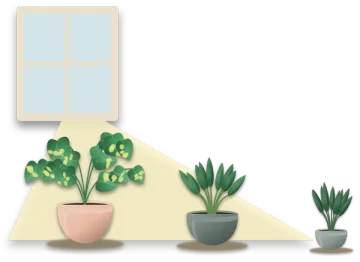
- Week one: full shade. Under a table, against a north facing wall in the northern hemisphere or a south facing one in the southern, or under a dense shrub. No direct sun at all.
- Week two: dappled light or an hour of early morning sun.
- After that: move it to wherever it is going to live, and for anything that will end up in real sun, get there over another week rather than in one step.
Even a jade plant, which will happily take full sun once hardened, scorches after a winter indoors.
Two other things change outside. Wind dries a plant far faster than still indoor air, so a pot that wanted water weekly indoors may want it every second day on a patio. And rain does not water a potted plant reliably: a leafy plant acts as an umbrella over its own pot, and a pot can be bone dry after a wet week.
Coming back in: check it first
Do this before the plant crosses the threshold, and do it properly. Once it is inside, whatever came with it has six months of warmth, no rain, no wind and no predators.

- The undersides of the leaves, for aphids, scale and red spider mite.
- The leaf joints, for mealybug, which looks like small blobs of cotton wool.
- Under the pot rim and under the pot itself, for slugs and snails.
- The compost surface, and the top two centimetres, for vine weevil grubs, which are fat white larvae with brown heads and will hollow out a root system over a winter without you seeing them.
A thorough rinse with a hose, including the undersides, takes five minutes and removes most of it. If a plant is visibly infested, deal with it outside rather than indoors.
While you are there, take the chance to tidy: remove dead leaves, and check whether the pot has filled with roots over the summer, which many will have. Note it for next spring rather than repotting now.
Coming back in: the timing
Before the first cold night rather than after it. In the northern hemisphere that means September for anything tender and early October for the tougher things; south of the equator, March and April.
Watch the forecast for the first night below about ten degrees and bring things in ahead of it. A plant that has taken one cold night will often look fine for a fortnight and then drop every leaf. Dragon trees are particularly good at this delayed reaction.
Expect some leaf drop anyway. Moving from bright outdoor light to a windowsill is a large drop in light, and the plant sheds the leaves it can no longer support. That is normal and it is not a reason to water more.
What changes indoors, either way
The watering interval is the whole of it, and it follows the light rather than the temperature.
From about midsummer the days shorten, growth slows, and the same plant in the same room needs water less and less often. By midwinter the interval may have doubled. Then it closes again over a few weeks in spring. Nothing about the flat changes, which is exactly why so many plants are lost in January: the routine did not change either.
The log slides between a plant’s summer and winter intervals on a curve across the year rather than jumping on the first of a month, and it reads the curve for your hemisphere, so January is high summer if you are south of the equator. It also takes account of the light the plant is in and the size of its pot. If you have moved a plant, tell the log where it is now, because a plant that has come in from a patio to a hallway is in a different place as far as the maths is concerned.
Feeding stops when growth stops. Most plants get nothing from the middle of autumn to early spring, and fertiliser given to a plant that is not growing simply builds up in the compost as salt.
The plants that never come in
Anything hardy enough to stay outside all year has the opposite problem, which is winter wet rather than winter cold. Far more container plants are lost to compost that never dries than to frost.
Three things fix most of it. Raise the pots onto feet or bricks so the drainage holes are clear of the ground, because a pot standing in a saucer of rainwater in November is a pot with no air in it by January. Move them against a wall, which is both warmer and drier than the open garden. And stop feeding, because soft growth put on late in the year is the growth that the first frost takes.
Terracotta is the other thing to think about. Unglazed clay absorbs water, and water freezing inside the wall of a pot is what splits it, so a frost proof pot and a frost resistant pot are not the same claim. Anything precious is better emptied and turned upside down for the winter.
Two things worth doing at the same time
The move out and the move in fall in the same weeks as a good deal of house work, which has its own list: airing and washing the windows in spring, and the whole business of getting ready for the cold in autumn. Doing the plants at the same time as the gutters is not a coincidence. Both are being driven by the same fortnight of weather.
And if a plant has spent a summer outside and come back twice the size, it is a candidate for propagation rather than a bigger pot. Hoyas and monsteras both root readily from cuttings taken in the growing season, which is a better answer to a plant that has outgrown its corner than a pot you cannot lift.