What light levels actually mean in a real room
About 7 minutes to read. Published . By the House & Hedge team.
Light is the one thing every plant label gets vague about, because the words used are relative and the person reading them has a real room. Bright indirect light means nothing until you know whether your kitchen counts. This guide is an attempt to say what the three levels mean in a house you can walk around, and how to work out which one you are standing in.
Start with which way the window faces
Everything else follows from this, and it is the fact people most often do not know about their own home. A phone compass will tell you in ten seconds.
In the northern hemisphere:
- A south facing window gets direct sun for most of the day. It is the brightest light in the house and in summer it is strong enough to scorch a leaf that has spent the winter elsewhere.
- East gets direct morning sun, which is gentle, and bright indirect light for the rest of the day. It is the best all round window for houseplants there is.
- West gets direct afternoon sun, which is hotter and harsher than the morning kind, and dimmer light in the morning.
- North never gets direct sun at all. It is steady, gentle, and much better than its reputation.
South of the equator, swap north and south and leave east and west where they are. A north facing window in Johannesburg or Auckland is the bright one; a south facing window is the gentle one. That is the single most common mistake in gardening advice written for one hemisphere and read in the other.
The three levels, in plain terms
Full sun means direct sunlight falls on the leaves for four hours or more. On a windowsill that means the brightest window in the house, unshaded. Very few houseplants want this, and the ones that do are mostly succulents and cacti, which is why jade is happy on a sill that would scorch almost anything else.
Bright indirect means the plant can plainly see a large piece of sky, but the sun itself only touches it briefly if at all. This is what most houseplants mean when they say they want bright light, and it covers a lot of ground: right beside a gentle window, a metre back from a bright one, or beside a bright one with a net curtain over it.
Medium means a decent amount of daylight without a direct view of much sky. Two or three metres into a room from a bright window, or right beside a small one. Plenty of good plants prefer this, including calathea, which is a forest floor plant and finds a bright sill unpleasant.
Low means you can read a book comfortably in the daytime without a lamp, and no more. A hallway with a door open to a lit room. The far corner of a living room. A snake plant or a ZZ plant will live here for years, growing slowly. Most other things will slowly stretch and fade.
Two tests you can do this afternoon
The shadow test. On a bright day, hold your hand about thirty centimetres above where the plant sits, over a sheet of white paper.
- A hard shadow with sharp edges is full sun.
- A soft shadow you can clearly make out is bright indirect.
- A faint, vague shadow is medium.
- No real shadow at all is low light.
The sky test. Sit where the plant sits and look at the window. How much sky can you see? A plant does not care how bright the room looks to your eyes, which adjust; it cares how much sky it can see, because that is where the light comes from. This is why a plant one metre to the side of a window is in far worse light than one directly in front of it at the same distance, and why a deep windowsill can be dimmer than the edge of a shallow one.
Distance is the thing people get wrong
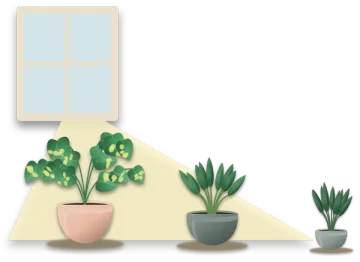
Light falls away far faster than it feels like it should. A plant on a windowsill and the same plant two metres into the room are in genuinely different conditions, and the difference between one metre and three is more than the difference between an east window and a west one.
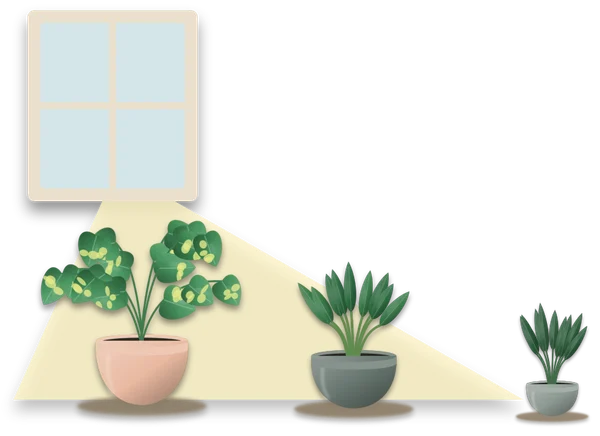
If you take one practical thing from this guide, let it be that moving a struggling plant a metre closer to the glass is more likely to help than anything you could buy for it.
What a plant does when the light is wrong
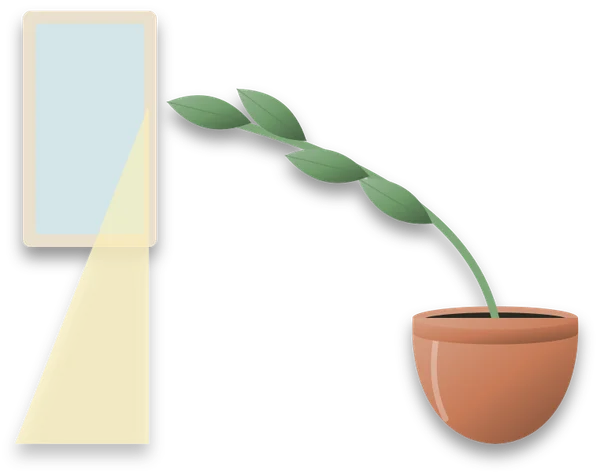
Too little. New leaves come out smaller than the old ones. The gaps between leaves get longer, which is the plant reaching, and the stem leans towards the window. A pothos in a dim corner produces small pale leaves on long bare stretches of stem, and a variegated one loses its variegation entirely, because the pale parts of a leaf cannot photosynthesise and the plant cannot afford them.
Too much. Pale bleached patches on the leaves that were facing the glass, brown crisp edges, and in succulents a red or purple flush. Scorch does not heal. The marked leaf stays marked for as long as it is on the plant, which is why the fix is to move the plant rather than to wait and see.
The seasons change the answer
A south facing sill in July and the same sill in January are two different places. The sun is lower and weaker in winter and the days are short, so a plant that was scorching in summer may be exactly right in winter, and a plant that was comfortable in a medium spot in July may be starved by December.
Two habits follow. First, move plants closer to the glass for the winter and back a little in spring, and give anything that spent winter in a dim corner a gradual reintroduction rather than a sudden move to the brightest window. Second, clean the glass. In midwinter, at the point in the year when every bit of light matters, a dirty window is a real loss.
Turn the pots a quarter turn each week while you are at it, or everything leans.
Choosing a plant for a place, rather than a place for a plant
This is the right way round and it is the harder discipline, because the plant you fell for in the shop was grown under shade cloth in a Dutch greenhouse and will tell you nothing useful about your hallway.
Work out the light first, then choose. The finder filters the whole journal by light level along with pet safety and how thirsty a plant is, which is a faster route than reading forty entries. And if a plant is already struggling, the log will tell you what its watering interval should be in the light it is actually in, because low light stretches the interval and bright light shortens it.
The one thing not worth doing is buying a plant for a room and hoping. A fiddle leaf fig in a dim corner is not a plant that needs more care. It is a plant in the wrong room, and no amount of attention fixes that.