Choosing a pot
About 7 minutes to read. Published . By the House & Hedge team.
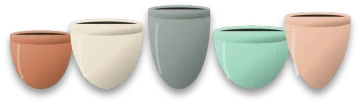
A pot decides more about a plant’s care than almost anything else on this site: how often it needs water, how easily its roots can rot, and how soon it needs repotting again. Three things matter, in order: the drainage hole, the size, and only after both of those, the material.
The drainage hole is not optional
Water needs somewhere to go once the compost has taken what it can hold. Without a hole, the bottom of the pot fills and stays full, and roots sitting in standing water drown in exactly the way the overwatering guide describes, however carefully you otherwise water.
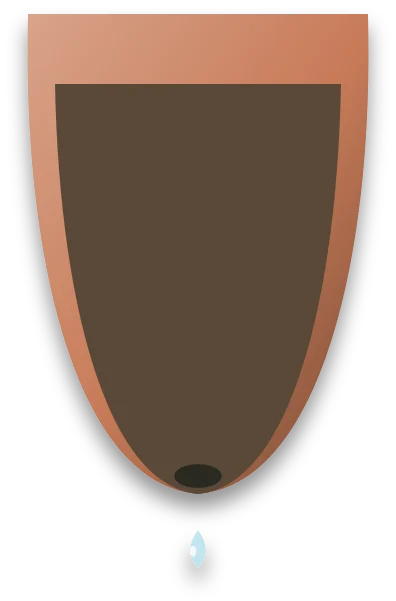
A pot without a hole is not a lost cause, only a container for the plant’s real pot: keep the plant in a plastic nursery pot with a hole, and stand that inside the decorative outer one. Lift the inner pot out to water over a sink, let it finish draining, and only then put it back. It takes a minute longer and it is the difference between a decorative pot being a display case and being the thing that eventually kills the plant.
Size: one up, not several
The rule is the same one repotting uses, because it is really the same question asked at a different moment: 2 to 4 cm more across than the current pot for a small plant, about 5 cm for a large one. A pot several sizes too big holds far more compost than the roots can dry out between waterings, and compost with no roots growing through it simply stays wet.
This matters most exactly when it feels least intuitive: buying a first pot for a plant that will clearly get much bigger. A young rubber plant does better started in a pot that fits its current roots and moved up gradually than in one bought to fit the plant it will be in two years.
Material: match it to how the plant likes to be watered
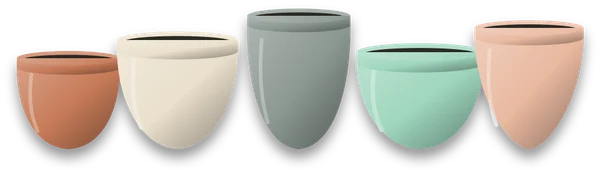
Terracotta is porous clay. Air and moisture pass through the walls, so compost inside dries noticeably faster and more evenly than the same compost in plastic. That suits succulents such as echeveria and jade plant, and it suits anyone who tends to water on a fixed schedule rather than checking the compost first, since terracotta forgives a slightly early watering better than it forgives a late one.
Plastic and glazed ceramic hold moisture far longer, since neither lets water pass through the wall at all. That suits calathea and other plants that dislike drying out fully between waterings, and it suits anyone prone to underwatering rather than over. Plastic is also lighter, which matters once a plant is large enough to need two hands to move.
Specialist pots exist for a reason rather than as decoration. Moth orchids are usually grown in clear plastic pots with slits or extra holes down the sides, because orchid roots photosynthesise and need to see light, and because bark mix needs far more airflow than ordinary compost. A moth orchid in an opaque pot with a single bottom hole is fighting its own growing medium.
Depth and shape, not just diameter
Root shape varies as much as the plant above it does, and a pot chosen only by width can still suit the roots badly. Moth orchids have thick, wide-spreading roots that want a shallow, wide pot with plenty of airflow around them, not a deep one. A plant with a single long taproot, many herbs among them, wants depth more than width, and a wide shallow pot leaves the root with nowhere to go. Most foliage houseplants fall between the two and are forgiving of either, but it is worth checking a plant’s own guide before assuming width is the only dimension that matters.
Self-watering pots
A self-watering pot holds a reservoir below the compost, usually with a wick or a raised platform drawing water up as the compost dries, and a window or float to show the water level. They suit plants that dislike drying out, calathea among them, and they suit anyone prone to underwatering more than the plants themselves particularly need one.
They suit succulents and other drought-tolerant plants far less well, since the reservoir keeps the compost consistently damper than those plants are built for, and a self-watering pot for a succulent tends to recreate exactly the overwatering risk the pot was meant to prevent. Read the plant’s own watering habit before choosing one, rather than assuming a self-watering pot is simply better across the board.
Hanging planters
A hanging planter answers a location problem, not a drainage one, and the drainage rules above still apply in full: a hole, and a saucer or cachepot beneath it to catch runoff rather than letting it drip onto whatever is below. A hanging planter with no way to drain, chosen because there is nowhere obvious to put a saucer at that height, is worth reconsidering rather than worked around, since the compost inside still floods exactly as it would anywhere else.
Trailing plants that naturally grow downward, pothos among the most common, suit the position visually as well as practically, since the growth habit does the work a flat surface display cannot.
Grow bags and fabric pots
A fabric or grow bag pot lets air reach the compost through the whole side of the container, not just the bottom, which air-prunes roots at the fabric wall rather than letting them circle endlessly the way they do inside solid plastic. That produces a denser, more branched root system and dries faster than an equivalent plastic pot, closer to terracotta’s drying behaviour than to plastic’s. They suit an outdoor or balcony plant more often than an indoor one, since they need a saucer or tray underneath just as any other pot does, and a fabric pot with no tray leaks onto whatever surface it sits on.
Upcycling a container
An old tin, a teapot, a wooden crate: any of these can hold a plant provided a hole can be added without destroying the container, or provided the same nursery-pot-inside-a-cachepot approach described above is used instead. Drilling a metal or plastic container is usually straightforward with the right bit; drilling glass or unglazed ceramic is far more likely to crack the piece than succeed, and is not worth attempting on anything with sentimental or resale value.
Saucers and cachepots
A saucer under a pot is for catching runoff, not for storing it. Empty a saucer within an hour of watering; water left standing in it gets drawn back up into the compost by capillary action, which quietly undoes the whole point of a drainage hole.
A cachepot, a decorative outer pot with no hole of its own, works exactly like the container described above: something to lift the inner, actually-draining pot out of before it sits in runoff for any length of time.
Working out how much compost a new pot needs
Compost is sold by the litre or in bags, not by the pot, and it is always more than it looks like you will need for a single pot change. The mulch and soil calculator converts a pot’s size into litres and bags before you go to the shop, which saves a second trip far more often than it seems like it should.