Repotting without killing the plant
About 8 minutes to read. Published . By the House & Hedge team.
Compost calculator
Work out how much fresh compost to buy when you move a plant up to a bigger pot.
Measure across the inside of the pot.
Repotting is the job most people do too often, at the wrong time of year, and into a pot several sizes too big. Done properly it is the single biggest thing you can do for a plant that has stalled. Done in October into a bucket of fresh compost, it is how a healthy plant becomes a dead one over a winter.
When it actually needs doing
Four signs, and they are all about roots rather than about the plant looking big.
Roots out of the drainage holes. The clearest of the four. If you can see roots underneath, the pot is full.
Water runs straight through. You water, and it comes out of the bottom within seconds while the pot barely gains any weight. That is a root ball so dense there is almost no compost left between the roots.
It dries within a day. A plant that needs water every second day in spring is not thirsty, it is root bound. There is nothing left in the pot to hold water.
Roots circling on the surface, or the plant lifting itself out of its pot, or the pot bulging.
What is not on that list is a plant that has grown taller, a plant that has been in the same pot for two years, or a plant that is unhappy for reasons you cannot place. A leggy plant needs light. A plant with yellow lower leaves is usually being watered too often. Repotting either of those adds a shock to an existing problem.
Some plants genuinely prefer to be crowded and flower better for it. Moth orchids are repotted when the bark medium breaks down rather than when the roots fill the pot, and agapanthus and clivia sulk for years after being divided.
One size up, and why it matters
Two to four centimetres more across for a small plant, five for a large one. That is the whole rule, and it is broken more often than any other piece of houseplant advice.
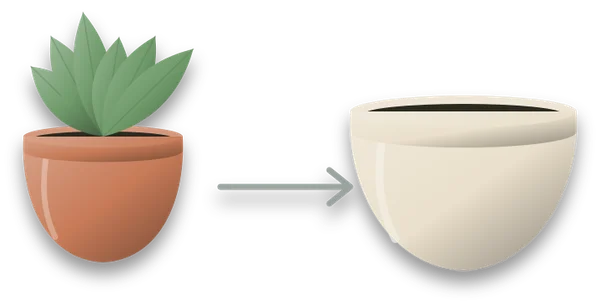
The reason is not that the plant dislikes room. It is that compost with no roots in it stays wet. Roots pull water out of the compost around them and let air back in behind it; compost with nothing growing in it just sits. Put a small root ball in the middle of a large pot and you have created a ring of permanently wet compost around it, and the roots grow out into that and rot.
This is why the same plant, watered by the same person on the same day of the week, thrives in a snug pot and dies in a generous one.
Drainage holes are not optional. A decorative pot with no hole is a container for a plastic pot, not a pot.
The time of year
Early in the growing season. That means March to May north of the equator and September to November south of it, and the reason is the light rather than the temperature.
Repotting asks a plant to grow roots into new compost. It can only do that while it is growing, and it only grows while there is light. A plant repotted in early spring fills its new pot within a few weeks and is better for it all summer. The same plant repotted in October sits in wet unused compost for five months, which is exactly the condition root rot needs.
If a plant is genuinely suffering, root rot or a broken pot, repot it whenever you find it. That is a rescue rather than a repot, and the rules are different.
Compost
Use fresh compost, not garden soil and not what was in the last pot. Garden soil compacts in a container, holds too much water and brings its own passengers.
Most houseplants want a peat free multipurpose compost with something added for drainage, which means perlite, fine bark or horticultural grit at roughly one part to four. The exceptions matter:
- Succulents and cacti such as jade want at least a third grit, and a bought cactus compost is usually still not gritty enough.
- Orchids want bark, not compost at all.
- Ferns and calatheas want more organic matter and less grit than the average.
- Citrus wants a specific citrus compost, because of how it takes up iron.
Work out how much you need before you go to the shop. It is always more than it looks: the mulch and soil calculator does it in litres and bags, which is how compost is actually sold.
How the calculator works
The compost calculator works out how much fresh compost to buy for a move to a bigger pot. Enter the width across the top, the width across the base and the depth of the new pot and of the old one, all in centimetres. It gives each pot’s volume in litres and the compost to buy, rounded up to the next half litre.
A pot tapers, so its volume is that of a cone with the narrow end cut off: V = pi x h / 3 x (R x R + R x r + r x r), where h is the depth, R is half the width across the top and r is half the width across the base. The compost to buy is the new volume minus the old volume, because the root ball already fills the old pot. With the defaults, the new pot (18 cm across the top, 13 across the base, 16 deep) holds 3.05 litres and the old one (15, 11 and 14) holds 1.87 litres. The difference is 1.18 litres, so buy 1.5 litres.
The sum only makes sense for one size up, which is two to four centimetres more across for a small plant and five for a large one. A pot much bigger than the root ball holds water the roots cannot reach, and compost with no roots in it stays wet, which is where rot starts. If the new pot is more than five centimetres wider, the working says so.
Both volumes are to the brim, but the guide leaves about two centimetres clear above the compost for watering, so a little compost will be spare. Measure across the inside of each pot. If your mix needs drainage added, roughly one part perlite, fine bark or grit to four, count that as part of the amount.
Doing it
- Water the plant thoroughly the day before. A dry root ball crumbles and tears; a damp one comes out whole.
- Put a few centimetres of fresh compost in the bottom of the new pot and check the height by sitting the old pot inside it. The plant should end up at the same depth it was before, with two centimetres of clear rim above the compost for watering.
- Get the plant out by squeezing the sides of a plastic pot or running a knife around a rigid one. Never pull it out by the stem.
- Look at the roots. Healthy roots are firm and pale. Anything brown, soft or smelling sour is dead, and should be cut off with clean scissors. If the roots are circling tightly, tease the bottom third loose with your fingers.
- Sit it in the new pot and fill around the sides, firming gently with your fingers rather than pressing hard. Compost rammed down has no air in it.
- Water once, thoroughly, until it runs out of the bottom, and empty the saucer.
The three weeks afterwards
This is where repotting goes wrong more often than in the doing of it.
Do not feed. Fresh compost has enough in it for six to eight weeks, and feeding damaged roots scorches them.
Do not water on the old schedule. The pot is bigger, the compost is fresh and there are fewer working roots, so it will dry far more slowly than it did before. Go back to feeling the compost every time. The log will offer you an interval based on the new pot size once you update it, and that is worth doing rather than carrying the old number over.
Do not move it into brighter light. A plant with disturbed roots cannot support the water loss. Keep it where it was, or slightly shadier, for a fortnight.
Expect a pause. Two or three weeks of no visible growth is normal, and a wilted leaf or two in the first week is not a sign to water more.
When not to repot at all
If the plant is fine and the pot is not full, leave it. Top dressing is the alternative and takes five minutes: scrape off the top three centimetres of old compost, replace it with fresh, and feed as usual. That gets a large plant, a rubber plant or a mature monstera, through another two or three years without the shock or the weight of a full repot.
And if a plant has been in the same pot for years and is perfectly happy, a ZZ plant being the usual example, the honest answer is that it does not want anything from you at all.