Feeding your plants
About 7 minutes to read. Published . By the House & Hedge team.
Feed dilution calculator
Work out how much liquid feed to add to your watering can.
Read the dose for ordinary strength from the bottle.
The guide says half strength for most houseplants and quarter strength for moth orchids.
Three numbers on every bottle, in the same order every time: nitrogen, phosphorus, potassium, shortened to N-P-K. A bottle marked 10-10-10 is one tenth nitrogen, one tenth phosphorus and one tenth potassium by weight; the rest is water or filler. Understanding what each one actually does takes most of the guesswork out of choosing a feed.
What each number is for
Nitrogen (N) drives leafy, green growth. It is the number that matters most for a foliage plant such as a monstera or pothos, where the leaves are the whole point.
Phosphorus (P) supports root development and, later, flowers and fruit. A feed with a higher middle number is usually marketed for flowering or fruiting plants, a tomato being the clearest houseplant-adjacent example.
Potassium (K) supports overall resilience: how well a plant copes with stress, fights disease and regulates water within its own cells. It matters across almost everything, which is why it is rarely the number that varies much between a “foliage” feed and a “flowering” feed.
A balanced, general-purpose houseplant feed with roughly equal numbers suits most of what grows on a windowsill. Reach for a feed with a different balance only once a specific plant asks for it, rather than buying three bottles before you own three plants.
How much, and how often
Half the strength the bottle recommends, every two to four weeks, through the growing season. Feed manufacturers write dosing instructions to sell more feed as much as to grow better plants, and a half-strength feed given regularly is far more forgiving of a missed week than a full-strength feed is of an accidental double dose.
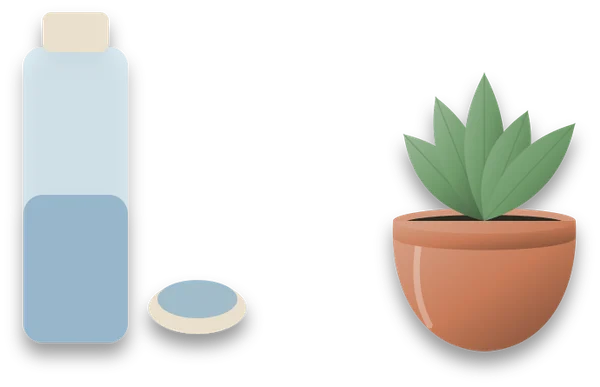
Liquid feed diluted into the watering can is the easiest way to keep to this: feed on a normal watering day rather than as a separate event, so it is one thing to remember rather than two.
How the calculator works
The feed dilution calculator works out how much liquid feed to add to your watering can. Enter the label dose in millilitres per litre, choose full, half or quarter strength, and enter the size of the can in litres. It gives the millilitres of feed to add.
The sum is: feed in ml = label dose x strength x can size, where strength is 1 for full, 0.5 for half and 0.25 for quarter. With a label dose of 5 ml per litre, half strength and a 2 litre can, that is 5 x 0.5 x 2 = 5 ml of feed in 2 litres of water.
Half strength is the default because the guide says to feed at half the strength the bottle recommends, every two to four weeks, through the growing season. The reasoning is that dosing instructions are written to sell more feed as much as to grow better plants, and a half-strength feed given regularly is far more forgiving of a missed week than a full-strength feed is of an accidental double dose. Too much feed builds up dissolved salts in the compost, which show as a white crust and crisping leaf tips. Moth orchids are the exception and want quarter strength, because ordinary houseplant feed is generally too strong for their bark-grown roots.
The calculator needs the dose in millilitres per litre, so if the label gives it another way, work that out first. It does not know your plant, so read the exceptions for succulents and orchids. A seedling or cutting recently potted on needs no feed for the first month, and feeding stops once growth slows for the season.
The exceptions
Jade plant and other slow-growing succulents need a fraction of what a fast grower does, at most once a month through summer and not at all the rest of the year. Feeding a slow succulent on a foliage plant’s schedule pushes soft, weak growth that the plant’s usual sturdy structure was never built to support.
Moth orchids want a feed formulated for orchids specifically, at quarter strength, because ordinary houseplant feed is generally too strong for bark-grown roots that have almost no compost buffering the concentration around them.
Organic and synthetic feeds
An organic feed, seaweed extract or worm castings among the common houseplant options, releases its nutrients gradually as microbes in the compost break it down, and tends to feed the compost’s own biology alongside the plant. A synthetic feed supplies nutrients in a form the plant can take up immediately, which makes dosing more predictable and overfeeding easier to cause by the same token, since there is no slower breakdown step buffering a heavy hand with the bottle.
Neither is inherently better for a houseplant kept in a small volume of compost indoors; the practical difference is mostly about how forgiving the timing needs to be and how quickly a correction takes effect once you spot a problem, both of which favour the synthetic route for a beginner still learning to judge a plant’s own signals.
Liquid, granules or foliar: how a feed is applied
Liquid feed, diluted into the watering can, is the easiest to control and the easiest to give at half strength, which is why it suits most houseplants best. It acts within days rather than weeks, which also makes overfeeding visible sooner, before too many feeds have compounded the problem.
Slow-release granules, worked into the compost surface or mixed in at potting time, release their feed gradually over one to several months rather than all at once. They suit a plant that is easy to forget about, since one application covers a whole season, but they are harder to stop partway through: once granules are in the compost, there is no equivalent to simply not adding the next liquid feed.
Foliar feeding, spraying a very dilute feed directly onto the leaves rather than watering it into the compost, is absorbed faster than a root feed and is occasionally used to correct a specific, fast-developing deficiency. It is not a substitute for regular root feeding and is worth treating as a rare, targeted tool rather than a routine method.
Micronutrients, and the yellowing that is not about nitrogen
Not every yellowing plant needs more feed overall; sometimes it is a single micronutrient the compost has run short of or the plant cannot access, and adding a general N-P-K feed does nothing for it. Iron deficiency shows on new growth first: the tissue between the veins turns pale yellow or almost white while the veins themselves stay green, a pattern called interveinal chlorosis. Magnesium deficiency shows the same interveinal pattern but on older leaves rather than new ones, since magnesium is mobile within the plant and gets pulled from old growth to support new growth when it is scarce.

Both are more often a sign that compost pH has drifted too high for the plant to take up the micronutrient that is technically present, rather than a sign the nutrient is genuinely absent, which is part of why simply adding more of the same balanced feed rarely fixes it. A specialist feed containing chelated iron or added magnesium, applied according to its own label rather than folded into the general feeding routine above, addresses the specific shortfall directly.
Seedlings and very young plants
A seedling or a cutting only recently potted on has few working roots and very little tolerance for concentrated feed of any kind. Feed nothing for the first month after potting on, as the propagation guide and the repotting guide both note, and when feeding does start, begin at a quarter of the usual half-strength dose rather than jumping straight to an established plant’s routine.
The signs of too much
A white or crusty deposit on the surface of the compost or on the outside of an unglazed pot is usually the first visible sign: dissolved mineral salts building up faster than watering can wash them through. Yellowing that starts at the leaf edges rather than across the whole leaf, and crisping tips that spread inward rather than starting from a dry edge, both point the same way.
The fix is to flush the compost: water thoroughly, several times the pot’s own volume, letting it run straight through and out of the drainage hole each time, so the excess salts wash out rather than concentrating further. Stop feeding for a month afterwards and resume at a lower strength than before.
When to stop for the year
Feeding follows growth, and growth follows light rather than temperature, which is why it stops on roughly the same calendar rhythm as propagation and repotting, just running the other direction. New growth slows toward autumn: broadly September in the northern hemisphere and March in the southern. A plant fed through its own winter cannot use what it is given, and unused feed simply accumulates in the compost as the salt build-up described above.
Resume once new leaves start appearing again in spring, and use the log to note when each plant was last fed, since “roughly every few weeks” is far easier to keep track of against a date than from memory alone.