Propagating from cuttings
About 8 minutes to read. Published . By the House & Hedge team.
Most of what grows on a windowsill can be turned into a second plant for the price of a clean cut and a few weeks of patience. The three methods below cover almost everything: a stem cutting in water, a stem or leaf cutting straight into compost, and division, which is really just splitting a plant that has already made more than one of itself.
Stem cuttings in water
The method for anything that trails or climbs: pothos, tradescantia, philodendron, and most begonias and coleus. It also works for a monstera, though a monstera cutting needs a node with an aerial root already showing to root with any reliability.
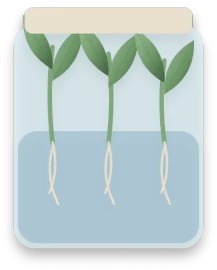
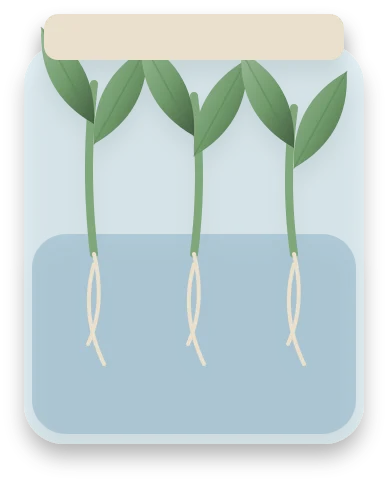
Cut just below a node, the small bump or ring on the stem where a leaf grows from and where the new roots will start. Four to six leaves’ worth of stem is enough. Strip the leaves from the bottom third so nothing sits under the waterline and rots.
Set the cutting in a jar of room-temperature water with the node submerged and the leaves clear of it, somewhere bright but out of direct sun. Change the water every few days rather than topping it up, so it never clouds. Roots usually show within two weeks for a fast grower and can take up to six for a slower one.
Pot it on once the roots are 2 to 3 cm long. Wait longer than that and the roots become adapted to water and sulk for a week or two after the move to compost; the plant recovers, but there is no advantage to leaving it in the jar once it is ready.
Stem and leaf cuttings straight into compost
Some plants root faster in compost than in water, and a few succulents only really work this way. Jade plant and most other leaf-succulents propagate from a whole leaf: twist it off cleanly at the base rather than cutting it, leave the cut end to callus over for a day or two in the open air, then lay it on the surface of dry, gritty compost. Do not bury it and do not water it yet. A tiny new plant forms at the base of the leaf over several weeks, drawing on water stored in the leaf itself; only start watering once that new growth appears.
For a stem cutting straight into compost, plant it the same depth as it would sit in water, keep the compost barely damp rather than wet, and hold humidity around it with a clear bag or a propagator lid loosely in place for the first fortnight. Check for root resistance after two or three weeks with a very gentle tug: resistance means it has rooted, and the bag can come off.
Air layering, for a thick or woody stem
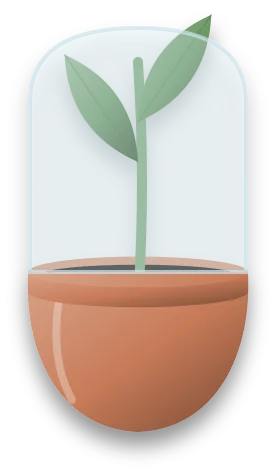
Some plants are worth propagating without ever cutting them free of the parent, because a stem thick enough to be a mature plant on its own can be slow or unreliable to root once separated. Air layering solves this by growing the new roots first, while the stem is still attached and still being fed and watered by the original plant, and only cutting it away once those roots exist.
Choose a node, ideally one already showing the start of an aerial root, and nick the stem lightly just below it with a clean blade to encourage rooting there. Wrap the node in a handful of damp sphagnum moss, wrung out so it is moist rather than dripping, and cover the moss in clear plastic wrap, tied off above and below so it holds moisture without letting it run down the stem. Check weekly by feel through the plastic; once roots are visible filling the moss, usually after several weeks, cut the stem free just below the new roots and pot the rooted section on its own.
This is the more reliable route for a rubber plant or a mature philodendron with a stem too thick to root easily as a simple water cutting, and it is worth the extra patience specifically because the parent plant keeps the cutting alive throughout, rather than the cutting having to survive on its own from the first day.
Hygiene and taking more than one cutting
Use a clean blade for every cutting, wiped with rubbing alcohol between plants at the very least and ideally between cuttings of the same plant too. A blade carrying rot or fungus from one cutting can introduce it to the next, and a cutting that starts to rot rarely recovers once it has begun.
Take two or three cuttings where the parent plant can spare them, rather than one. Not every cutting roots, even from an experienced hand and a healthy parent plant, and having a spare or two costs nothing beyond the leaves used to make them, while a single cutting that fails means starting the whole wait over again.
When a cutting is not working
A cutting that wilts hard within the first day or two, rather than settling and staying steady, was usually cut too short or lost too much of its root-bearing stem in transit; there is rarely anything to do beyond noting it and trying again with a longer cutting next time. A cutting that turns soft or discoloured at the cut end, rather than staying firm, has usually started to rot rather than root, and is worth discarding rather than persisting with, since a rotting cutting can spread that rot to clean water or compost around it.
A cutting that simply sits for many weeks with no visible change, staying firm and green but showing no roots at all, is more often a light or temperature problem than a lost cause: move it somewhere brighter, though still out of direct sun, and somewhere that does not swing cold overnight, before giving up on it.
Division
Some plants make the job even simpler by producing a second plant on their own. Chinese money plant sends up baby plants from its roots, called pups; once a pup has its own two or three leaves, it can be lifted with a spoon and its own small piece of root attached, then potted straight into fresh compost with no rooting stage at all.
Clumping plants such as ferns, calatheas and many succulents can be divided the same way at repotting time: tip the whole rootball out, and where it separates naturally into two or more crowns without much force, that is where to split it. Division skips propagation’s usual waiting period entirely, since each piece already has its own working roots.
When to do it
Spring into early summer is the growing season for propagation, the same window the repotting guide uses and for the same reason: a cutting can only grow new roots while it is actively growing, which needs light. That is March to May north of the equator and September to November south of it. A cutting taken in autumn or winter will often just sit, and is far more likely to rot than root before the light improves again.
After it roots
Pot a rooted cutting into a small pot rather than a large one, for the same reason a repotted plant gets one size up rather than several: compost with no roots in it yet stays wet, and a young root system cannot dry it out fast enough. Feed nothing for the first month; fresh compost has enough in it already, and a newly rooted cutting has little capacity to use more.
Add it to the log once it is potted, as its own plant with its own watering interval, rather than folding it into the parent plant’s schedule. A cutting in a small pot of fresh compost dries out and needs watering far sooner than the mature plant it came from.