Amaryllis care
About 9 minutes to read. Published . By the House & Hedge team.
An amaryllis bulb is bought for one thing: a thick, hollow stem and a few huge trumpet flowers about six to eight weeks after it is potted. The part that decides whether you get a second year of flowers is what you do after they fade, and that is where most people stop. This guide takes it from the box to the second flowering, and says where the timing differs between the hemispheres.
Two plants with one name
The plant sold as an amaryllis is not an Amaryllis. It is Hippeastrum, which the University of Wisconsin Extension says is native mainly to tropical and subtropical South America, with most modern hybrids coming from six of its roughly 90 species. The true Amaryllis, the belladonna lily, comes from South Africa. Both are in the amaryllis family, Amaryllidaceae, and the RHS notes that the mix-up is confusing: the true Amaryllis is hardy in the UK, whereas Hippeastrum is a houseplant.
The garden plant, Amaryllis belladonna, grows in the South Western Cape, according to SANBI PlantZAfrica, among rocks. It flowers in late summer, in February and March, on bare stalks before any leaves appear. The leaves come after the flowers, stay green through the winter and die back in summer, when the bulb is dormant. It wants the bulb planted with its neck at soil level and tolerates quite arid conditions. It is a garden bulb, and nothing else in this guide applies to it.
Potting the bulb
Choose the largest bulb you can, firm and dry with no mould, decay or injury; the University of Wisconsin Extension says bigger bulbs give more flowers. Use a pot only slightly wider than the bulb. The RHS says pots a little larger than the bulb itself, and the Wisconsin article says about an inch (2.5 cm) wider, because amaryllis like to be slightly pot-bound. The amaryllis entry says the same, that roots flower best when tight.
Use a free-draining compost: the RHS says peat-free John Innes No 2 or a peat-free general-purpose mix, and the Wisconsin article says a well-drained potting mix with plenty of organic matter. Firm it around the bulb and leave the top of the compost about an inch below the rim, so there is room to water.
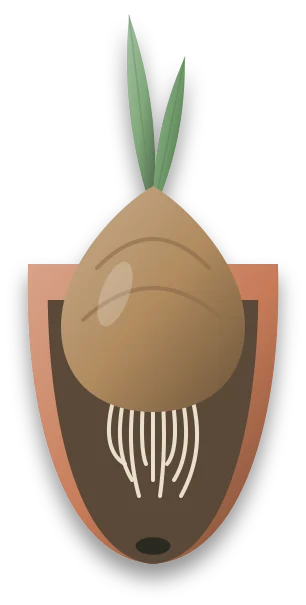
How much of the bulb stays above the compost differs between sources: two-thirds by the RHS, the top half by the Wisconsin article, and the top third in the entry here. In all three a good part of the bulb stands clear, so water at the edge of the pot, as the entry advises, and not over the neck.
Water, light and warmth
Water sparingly until the new leaves develop, the RHS says, then regularly, keeping the compost moist and emptying any water left in the saucer. The Wisconsin article says to keep it barely moist, because soggy compost can rot the bulb. Put the pot somewhere well lit at room temperature, about 21 °C by the RHS and 18 to 21 °C by the Wisconsin article, and turn it now and then so the stem does not lean towards the light. Large-flowered cultivars should be staked.
Warmth shortens the show. The Wisconsin article says warmer temperatures produce weaker flower stalks and smaller flowers, and that keeping the plant out of direct sun at 16 to 18 °C prolongs the flowers. The RHS says the same, moving the plant to 15 to 18 °C while it is in flower.
Timing for each hemisphere
The count that matters is six to eight weeks from potting to flowers. For flowers at Christmas, that puts potting between about the end of October and the middle of November, in either hemisphere. That is arithmetic from the sources’ week counts, not a schedule either of them gives. The RHS says October to January as its planting window, which suits a northern winter; the entry on this site says South African gardeners pot bulbs in spring and early summer.
What differs is the room. In the north the flowers open in a cool winter room, which suits them. In the south they open in midsummer, so the Wisconsin warning about warm temperatures matters more: choose the coolest bright spot in the house and keep it out of direct sun to hold the flowers longer.
After the flowers
Remove each faded flower with the swollen base under it so the plant does not set seed, the Wisconsin article says, and cut the whole stalk a few inches above the neck of the bulb once it turns yellow or brown. The RHS says to cut spent spikes to the base. Both keep the leaves, and this is the step to take seriously. The leaves feed the bulb: keep them watered and fed through the warm months and the bulb builds next year’s flower.
Wisconsin says to feed monthly with a complete fertiliser at the rate for houseplants and warns that stronger feeding builds up salts and burns the roots. The RHS says weekly with a balanced liquid feed. Follow the label and keep to the weaker end. Over summer the pot can go outdoors. The RHS says to shade it from harsh sun, and the Wisconsin article says to wait until frost danger has passed, start it in shade and work up to at least six hours of sun, and not to plant the bulb directly in the ground because the roots are brittle. The RHS says to repot every two or three years, after flowering.
The rest
A rested bulb flowers on cue. The RHS gives two methods. In the first, move the plant to a well-lit spot near 13 °C, stop feeding and reduce watering for eight to ten weeks, then cut the old leaves to 10 cm above the neck, refresh the top 2.5 to 5 cm of compost and start it again as a new bulb. In the second, stop watering and let the pot dry out, cut off spent leaves and store it somewhere cool for one to two months, with no light needed, then bring it indoors and restart.
The Wisconsin article gives eight to ten weeks of dormancy, in the dark and dry at 7 to 13 °C, such as a basement or closet, with the leaves removed only after they have dried. Growth returns and flowers follow about four to six weeks after you restart watering. It also says commercial amaryllis bulbs do not need a rest and will bloom if kept evergreen, so the rest is mostly about timing.
To flower again at Christmas, take eight to ten weeks of rest and about six weeks of growth, which comes to 14 to 16 weeks. Counting back puts the start of the rest in September, in either hemisphere. Again that is arithmetic, not a source’s timetable. The Wisconsin article asks for 7 to 13 °C in the dark, which in a warm house means a cellar, a garage or a cool cupboard rather than a living room.
If it does not flower, the RHS lists drying the bulb off too early, too much shade, and under-watering the previous summer. The hyacinth is the other bulb people force indoors, and its entry says forced bulbs rarely give a full flower again, which is why a rested amaryllis is worth the effort.
Pets
The ASPCA lists the amaryllis (Hippeastrum, listed as Barbados lily) as toxic to dogs and cats. It names alkaloids, including lycorine, as the toxic principle, and says the bulbs are the most dangerous part. Signs include vomiting, drooling and diarrhoea, and a large amount can cause seizures, low blood pressure, tremors and an irregular heart rhythm. Keep the bulb out of reach, and see what to do if a pet eats a plant if one has chewed it. NC State Extension also lists the garden belladonna lily as toxic to animals, with the same alkaloid.
Where to go next
The other festive plants are covered in plants for the festive season: the Christmas cactus and the cyclamen flower on their own rhythms, and poinsettia care covers the colour. The almanac shows both hemispheres side by side, and the log keeps each plant’s watering on a schedule through the months the bulb is growing.