Aloe, agave or haworthia: which one is it
About 7 minutes to read. Published . By the House & Hedge team.
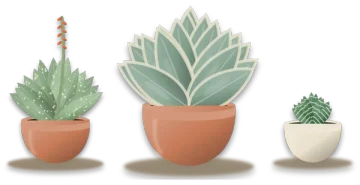
Three different plants get sold as aloe, or mistaken for it: a true aloe, a young agave and a small banded haworthia. They share a rosette shape and a taste for bright, dry places, so the mix-up is easy to make. It also matters, because the three differ in how large they get, in what their sap does to skin, and in whether a cat or dog that nibbles them is in trouble.
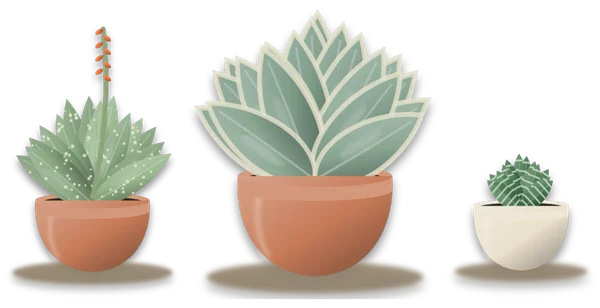
The one minute test
Size. NC State Extension gives zebra haworthia as 10 to 15 cm tall and wide. For aloe vera it lists 30 to 60 cm tall and 30 to 75 cm wide, and the RHS gives 0.5 to 1 m. For century plant, NC State Extension gives 1.8 to 3 m high and wide, with leaves that can reach 1.8 m long, and the RHS gives 1 to 1.5 m in cultivation. A rosette that stays small for years is likely a haworthia, and one that outgrows its pot every spring is more likely an agave.
The leaf edge. NC State Extension describes aloe leaves as thick, succulent and pointed, forming a rosette, with a margin of small white teeth, and the RHS calls the edges spiny. The teeth are small and the leaf itself is soft: NC State Extension says aloe leaves are soft and easy to break, with a gel-like sap inside. Agave is a different order of plant. The RHS describes spiny edged grey-green leaves and NC State Extension calls them large and spiny, thick and fleshy, and the century plant entry describes hooked teeth and a hard spine at the tip of each leaf. Haworthia has no teeth to speak of. NC State Extension describes stiff, thick, fleshy dark green leaves in a tight rosette.
The white bands. That leaves the banding, which is the haworthia’s trademark. NC State Extension describes raised white stripes on the outer surface of the leaf, with the upper surface smooth. It also names a look-alike, Haworthiopsis attenuata, that is often mistaken for it, and says the two can be told apart by where the stripes sit. A white mark alone is not enough, so look at the size and the teeth as well.
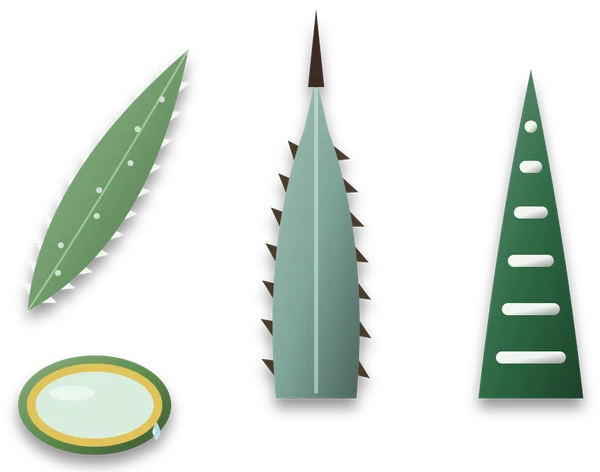
The sap. Snap an aloe leaf and the gel shows, which is why it is the plant of the kitchen windowsill. NC State Extension also mentions skin irritation from latex. Agave sap is a different matter. NC State Extension says the leaves and sap of century plant contain calcium oxalate crystals and that the sap causes contact dermatitis, and the RHS says it is a skin irritant and advises gloves and other protective equipment. Do not break an agave leaf to see what is inside. Haworthia does not have this problem, and the ASPCA lists it as non-toxic.
The flowers. Each makes a flower spike in its own way. NC State Extension says aloe vera bears tubular orange to yellowish flowers on a densely packed spike that can reach nearly 90 cm, and that a plant needs to be about three years old to bloom. The RHS gives greenish-yellow tubular flowers about 3 cm long on spikes of about 90 cm. Agave flowers once. NC State Extension says it takes 10 to 25 years, that the stalk is 4.5 to 9 m or more, and that once it flowers the main plant dies, leaving offsets round the base. Zebra haworthia’s flowers are small: NC State Extension describes tubular white flowers, under 2.5 cm long, on thin, long stalks.
Why the names get tangled
Plant names have moved around. NC State Extension lists Aloe fasciata and Haworthia fasciata among the former names of the zebra haworthia, now written Haworthiopsis fasciata, and the genus Haworthiopsis was formerly included within Haworthia. The ASPCA still lists it as Zebra Haworthia, Haworthia fasciata. This journal’s entry for zebra haworthia uses the older name that most labels use. Century plant is also called American aloe in this journal’s entry, though it is not an aloe.
The three come from different places. NC State Extension says aloe vera is native to the Arabian Peninsula and has spread to many other regions. Century plant comes from Mexico and the south-western United States, and the zebra haworthia from the Cape Provinces of South Africa, where it is commonly found buried in sand. See the aloe entry for aloe, and the guide to six southern African houseplants for more plants from the haworthia’s home region. Gasteria is another rosette succulent with an entry here.
Why it matters
Space. An agave sold young is not a houseplant for long. At a mature size of 1.8 to 3 m high and wide, with a flower stalk of 4.5 to 9 m or more, it is a plant for a sheltered patio or garden. The RHS rates it H2, which means it tolerates low temperatures but not being frozen, so in a cold climate it lives in a heavy pot under cover in winter.
Sap and skin. Agave needs gloves and care near the leaf tips. Aloe sap can irritate, and the guide to what to do if a pet eats a plant is worth reading before the day it happens.
Pets. The three give different answers, below.
Where the care is the same
All three want light, free drainage and long gaps between drinks. The RHS says aloe vera needs full sun, with moderate water while it grows and very sparingly in winter, and grows indoors in cactus compost. For century plant the RHS says to water moderately while it grows and to keep it almost dry in winter, and that it needs full sun. The three entries in this journal schedule a soak about every 14 days in the growing season and about every 35 in winter for aloe and for zebra haworthia, and about every 21 days and 60 for century plant. Add them to My plants and the scheduler turns those numbers into a calendar for your own seasons. Winter is the cold, short day part of the year: roughly June to August in the southern hemisphere and December to February in the northern.
Position follows the hemisphere. A south facing window in the northern hemisphere or a north facing one in the southern gets the most sun for aloe and agave. The RHS lists west and south facing for aloe in the north. The haworthia does better with bright indirect light or gentle direct sun, according to this journal’s entry, and harsh midday sun turns it red and then brown.
Pests are shared too. The RHS lists scale insects and mealybugs for aloe, and scale insects for agave, so the guides to mealybugs and scale insects apply. The plant finder can filter by light, difficulty and pet safety.
Pets and people
Aloe. The ASPCA rates aloe (Aloe vera) as toxic to dogs, toxic to cats and toxic to horses. The toxic principles are saponins and anthraquinones, and the signs are vomiting (not in horses), lethargy and diarrhoea. The ASPCA says the gel is considered edible, but a chewing animal does not separate the gel from the leaf. NC State Extension adds contact dermatitis as a risk for people, and the RHS says it is harmful if eaten by humans, dogs, cats and rabbits. If a pet has eaten any of it, call a vet.
Agave. The ASPCA toxic and non-toxic plants list has no entry for century plant or agave, so the rating for cats and for dogs is unknown, and this plant is not listed as safe until the entry has been checked. The RHS lists it as harmful to dogs and cats if eaten, and as a skin irritant. If a pet has eaten any of it, call a vet.
Haworthia. The ASPCA rates zebra haworthia (Haworthia fasciata) as non-toxic to dogs, non-toxic to cats and non-toxic to horses. Safe means not poisonous, not edible, and the ASPCA says eating any plant material may cause vomiting and gastrointestinal upset in dogs and cats, so keep it out of reach if you can. If a pet has eaten any of it, call a vet.
Does it matter which you have?
Yes, for three reasons. The agave needs a corner and gloves, the aloe is the one to keep out of reach of a chewing pet, and the haworthia is the small one that suits a desk. If you cannot tell at the shop, look at the leaf edge, press the leaf, and ask how big the plant on the label will become.