Poinsettia care
About 9 minutes to read. Published . By the House & Hedge team.
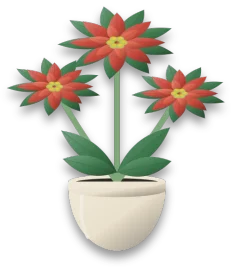
A poinsettia is sold at its best, in full colour, in the weeks before Christmas, and it is a plant with real needs: warmth, steady light and not much water. The two things that most often go wrong are cold, which the RHS names as the main cause of leaf and bract drop, and too much water.
The plant is Euphorbia pulcherrima, and it sits in the same genus as the crown of thorns, whose entry records a white sap that is a serious irritant. The care below is the same in either hemisphere. What changes is when the colour comes, and that is covered near the end.
What the red parts are
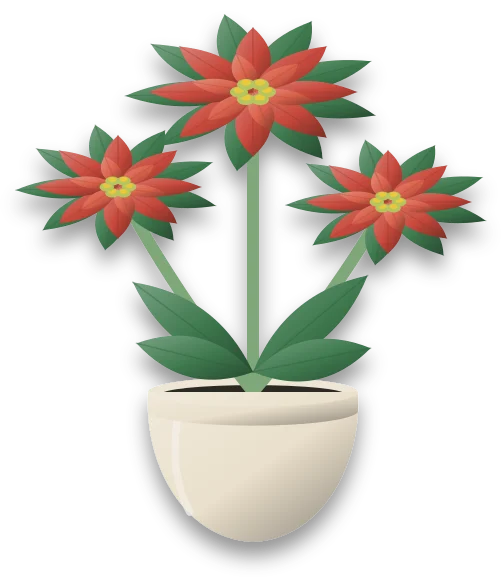
The showy red parts are not petals. Clemson Extension says they are bracts, modified leaves, and the true flowers are the small yellow clusters in the middle, which have no petals at all. The University of Maryland Extension says the same. Red makes up over three quarters of sales, and Clemson lists white, pink, peach, yellow, marbled and speckled forms as well.
That matters for care, because the bracts are what you are keeping. Clemson says the plant should be bought with its bracts fully coloured and its small yellow flowers still only partly open, and that direct sun can fade the bracts.
Getting it home
The RHS says most leaf and bract drop is cold damage, often from plants displayed on a pavement or in the draught from a shop door. Damage done before you buy cannot be undone, and the RHS says a plant that starts wilting and dropping straight after purchase will usually go on deteriorating whatever you do. Buy from a warm place, choose a plant that is not drooping or dropping, wrap it for the journey, and bring it in promptly. Buying on a mild day rather than a frosty one helps, which is the RHS advice for a British winter. In a southern December cold is less likely to be the problem and heat is the one to watch: keep the plant out of hot cars and sunny windows, because Clemson says excess heat makes leaves yellow and fall and bracts fade early.
Light, warmth and water
Light. The RHS says a bright, warm room out of direct sunlight, and Clemson says at least six hours of bright, indirect light, filtered if direct sun cannot be avoided.
Warmth. The RHS gives a minimum of 13 to 16 °C, and says cooler conditions cause a physiological shock. The University of Maryland Extension suggests 16 to 21 °C by day and nights down to about 13 °C, away from cold windows and drying heat. Clemson says to keep daytime temperatures at or below about 21 °C, and that chilling injury comes below about 10 °C. Keep the plant away from radiators, vents, fireplaces and draughty hearths, and from an unheated porch.
Water. The RHS says to water poinsettias sparingly, because overwatering can damage them, and only when the surface of the compost feels dry. It suggests standing the pot in tepid water for 10 to 20 minutes, letting it drain, and returning it to its decorative pot. Clemson says to remove any decorative cover before watering, and the University of Maryland Extension says to poke holes in any foil or plastic at the base of the pot so the roots do not drown. Neither wants the pot standing in a full saucer.
Feeding. Clemson says not to feed while the plant is in bloom. The RHS says feeding is only needed if you plan to keep the plant into the new year.
Why the leaves drop
Cold comes first, as above. Clemson lists excess heat, temperatures below about 10 °C, poor light and poor feeding as other causes of premature leaf drop, and says that overwatered or poorly drained compost can cause root rot. The University of Maryland Extension warns that drafts from vents, fireplaces, doors and windows cause leaf and flower drop, and says never to put a poinsettia near a cold window.
So check three things in order: is the spot warm and free of draughts, is it bright, and is the compost only just moist. If you have fixed all three and the drop stops, the plant is recovering. The diagnoser asks what else you are seeing if the cause is not obvious.
Pets and the sap
The ASPCA lists the poinsettia (Euphorbia pulcherrima, family Euphorbiaceae) as toxic to dogs, cats and horses, and gives the clinical signs as: Irritating to the mouth and stomach, sometimes causing vomiting, but generally over-rated in toxicity. The sources do not agree in tone. Clemson says poinsettia plants are not considered toxic, though eating foliage may cause stomach ache, diarrhoea or vomiting. The RHS says to avoid contact with the milky sap, which can irritate skin and eyes, that it is considerably less toxic than other euphorbias, and that the plant should not be eaten. Wear gloves for cuttings.
If a pet has chewed one, the guide to what to do if a pet eats a plant sets out the steps and the numbers to ring.
After the holidays
The RHS says to repot in spring or discard the plant after flowering, and that is a respectable choice. To keep it, the sources agree on the shape of the year even though they differ on dates: let the plant rest once the bracts fade, cut it back hard, grow it on in the warm months, and bring it back indoors before the nights turn cold.
The RHS says to prune back hard to about 10 cm in April, keep it near 13 °C, repot in early May, and give it a light, cool place for the summer. Clemson cuts back to about 20 cm in March or April, repots in early June and moves the plant outdoors once nights stay above about 10 °C. The University of Illinois Extension reduces watering once about half the leaves and bracts have fallen, stores the plant cool and dark, and cuts back in early May when growth restarts. Those months are British and American. In the south, follow the order, not the months: cut back after the bracts fade, repot as new growth starts, and move the plant outdoors only when frost danger has passed, as the University of Illinois Extension advises.
Feed lightly while it is growing, with a potassium-rich feed such as tomato feed once a month according to the RHS, and not while it is in colour. Do not expect the shop result. The University of Maryland Extension says a kept plant is unlikely to match a greenhouse-grown one in size and quality, and the RHS says shop plants are often treated with growth suppressants, so a plant grown on at home reverts to its natural, taller habit.
Getting colour again
Poinsettias are short-day plants. The bracts colour only after weeks of long, unbroken nights, and any light in that time sets the plant back.
The numbers from the sources agree closely. The RHS says eight to ten weeks of short days, aiming for under 12 hours of light a day, with the plant covered or moved to a dark room and kept away from any artificial light at night. Clemson says total darkness for 14 continuous hours each night for eight to ten weeks, with six to eight hours of bright light by day. The University of Maryland Extension says no more than 10 hours of daylight, and at least 14 hours of darkness, covering the plant in a closet or under a box in the evening, and that even a small light leak will prevent flowering. The University of Illinois Extension uses 5 pm to 8 am, and says nights above 21 to 24 °C may delay or prevent flowering. The RHS adds that the bracts colour best at a constant temperature of around 18 °C.
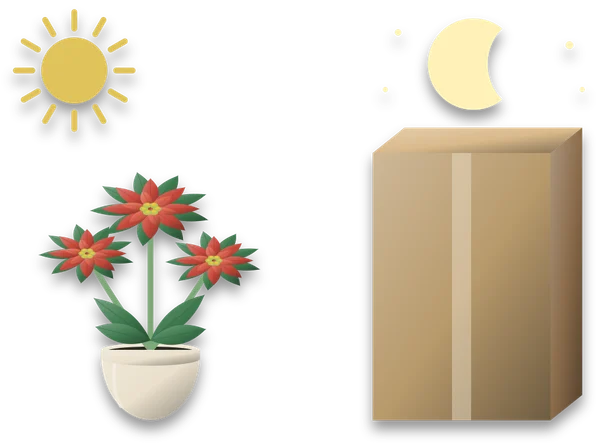
In the north the days are short enough on their own in December and January, but a plant wanted in colour for Christmas needs its nights lengthened from late September, which is why the RHS says to cover it or move it to a dark room. In the south Christmas falls on the longest days of the year, so a plant meant to colour for a southern Christmas has to be covered every evening for about ten weeks beforehand, through the lengthening days of spring and early summer. The sources are all written for a northern Christmas and none gives a southern schedule, so count back from the date you want colour rather than copying northern months. A plant left outdoors in a southern garden gets its short days in the southern winter, so it should colour then, but no source checked confirms the dates.
The same trick works on two other plants in the collection, which also set flower on long nights: the Christmas cactus and Flaming Katy, whose entries give 12 to 14 hours and 14 hours of complete darkness a night. The almanac lays out when each plant is due in both hemispheres.
Pests
The RHS says poinsettias generally do not suffer from pests and diseases, with grey mould from overwatering and the usual indoor sap feeders, scale insects and mealybugs, as the occasional problems. Clemson names whiteflies as the commonest insect pest, and spider mites, mealybugs and soft scale as others. Sticky leaves or white fluff mean you should read the guides to mealybugs, scale insects and spider mites. The croton is in the same plant family, and its entry names spider mites as its pest to watch.