Monstera or split-leaf philodendron: which is yours
About 7 minutes to read. Published . By the House & Hedge team.
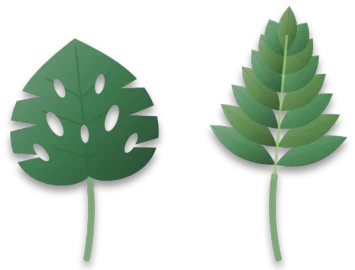
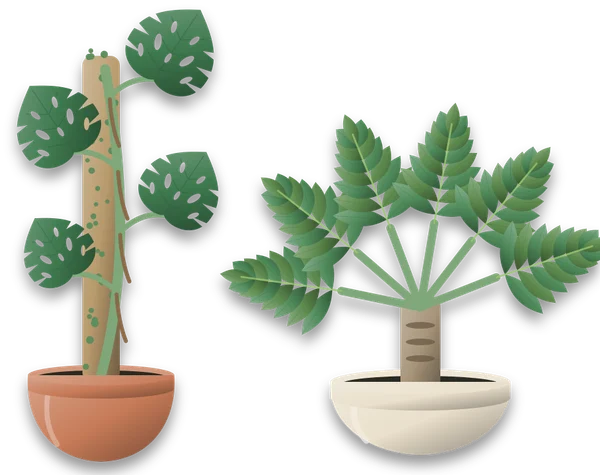
Walk into a plant shop and you can be handed two quite different plants under the same label, split-leaf philodendron. One is a climber with heart shaped leaves full of holes. The other is a spreading shrub whose leaves are cut into deep lobes. The names overlap because both are arums with big divided leaves, and NC State Extension lists split-leaf philodendron as a common name of each. Knowing which you own tells you whether to buy a pole or clear a corner.
The one minute test
Look at the edge and the middle of a full grown leaf, and count the holes.
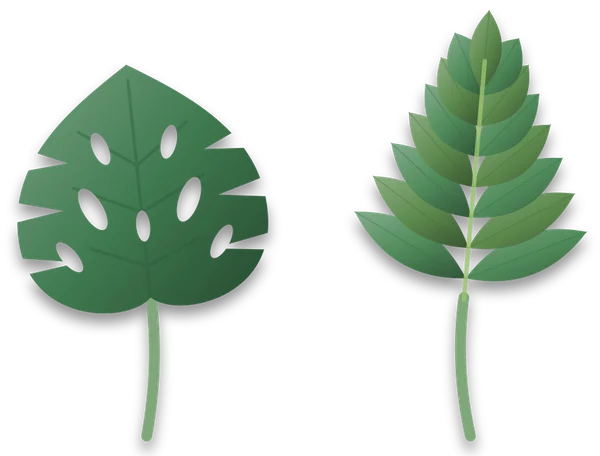
NC State Extension describes Monstera deliciosa as having leaves that are broadly ovate to heart shaped, deep green, shiny and somewhat leathery, with several holes across the blade. Some holes reach the edge and split the margin, so the leaf looks deeply lobed, but the outline is still one heart. NC State Extension says only mature leaves have these holes, and the RHS says the heart shaped leaves usually only show the distinctive holes once plants are a few years old, with fewer in very low light. So a young Monstera, or one in poor light, makes plain heart shaped leaves.
The tree philodendron is the other way round. NC State Extension describes its leaves as thick, shiny, dark green and deeply lobed, with the lobes cut halfway or more towards the midrib, and says the margins are wavy or smooth. The RHS describes long stalked leaves up to 1 m in length with feather-like divisions into slender, wavy margined segments. There are no holes, only lobes, and the cuts run in from the edge.
The stem tells you the rest
Monstera climbs. NC State Extension calls it a woody, perennial, broadleaf evergreen climbing vine with thick, long, leafy stems. In the forest it starts on the ground and climbs a tree. Indoors, NC State Extension says sturdy support is necessary to stop the stems breaking, and the RHS says to tie the plant to a moss pole kept damp so that the roots from the stems can grip.
The tree philodendron sprawls. NC State Extension describes a short, stout, green stem with prominent leaf scars, which reclines or creeps with age and will climb only if given support. The RHS calls it a bushy, shrub-like evergreen. Plants of the World Online at Kew calls it a scrambling shrub of seasonally dry tropical country. So where a Monstera runs upwards, the tree philodendron builds a trunk and spreads.
Size. NC State Extension says a Monstera stays between 1.8 and 2.4 m in most homes, while a tree philodendron can reach 1.2 to 3 m tall and 1.8 to 3 m wide, with leaves up to 1.2 m long. The RHS gives 2.5 to 4 m in both height and spread for the tree philodendron. A mature tree philodendron is the plant that outgrows a small room.
Flowers will not help. Both rarely flower indoors. The Monstera’s spathe is large and creamy white, followed by a fruit that NC State Extension says tastes like a mixture of banana and pineapple. The tree philodendron’s flower has a red-purple spathe, according to NC State Extension, and can take 10 to 15 years to appear indoors.
Why the names are confused
NC State Extension lists split-leaf philodendron among the common names of Monstera deliciosa, along with Swiss cheese plant, ceriman, hurricane plant and Mexican breadfruit, and adds that it is not actually a philodendron. The same list gives split leaf, tree, lacy tree and horsehead as common names of Philodendron bipinnatifidum. The ASPCA lists the Swiss cheese plant under other names too, including cutleaf philodendron, and lists the tree philodendron as Philodendron selloum.
The scientific name of the second plant has changed as well. Plants of the World Online at Kew accepts Philodendron bipinnatifidum and lists Thaumatophyllum bipinnatifidum as a synonym, while NC State Extension lists Philodendron selloanum and Thaumatophyllum bipinnatifidum as former names. A 2018 paper in PhytoKeys argued from molecular and morphological evidence for recognising Thaumatophyllum, formerly Philodendron subgenus Meconostigma, as a genus of its own. Which name a label uses depends on which treatment the grower follows, and all three refer to the same plant. This journal keeps it under the tree philodendron.
Two cousins add to the confusion. The RHS says the smaller Monstera adansonii is also called the Mexican breadfruit plant, and it is a climber too, so see the entry for Monstera adansonii. NC State Extension says the tree philodendron is often confused with the heartleaf philodendron, which is a climber with plain heart shaped leaves, covered in the entry for heartleaf philodendron.
Where each one comes from
Plants of the World Online at Kew gives the native range of Monstera deliciosa as Mexico (Veracruz, Oaxaca and Chiapas) to Guatemala. It gives eastern Bolivia, south-eastern and southern Brazil and north-eastern Argentina for the tree philodendron. The first climbs trees, and the second is a plant of seasonally dry country, which fits their different shapes.
Where the care is the same
Both want bright, indirect light, without hot direct sun. The RHS says a Monstera likes a spot near a west or east facing window, and that direct sun can scorch it. For the tree philodendron the RHS says partial shade, and under glass bright filtered light with shade from hot sun. Both want compost that drains. The RHS says to let a Monstera’s compost become almost dry before watering thoroughly, and to water the tree philodendron moderately while it grows and sparingly at other times. The Monstera entry schedules a drink about every 7 days in the growing season and about every 12 in winter, and the tree philodendron entry about every 7 days and about every 14. Add either plant to My plants and the scheduler turns those intervals into a calendar for the seasons where you live. The growing season is spring to early autumn, and the rest period is the cold, short day part of the year: roughly June to August in the southern hemisphere, and December to February in the northern.
Feeding is also the same. The RHS says to feed both with a balanced liquid fertiliser during growth. For pests, the RHS lists mealybugs and other sap sucking insects for the Monstera and scale insects and glasshouse red spider mite for the tree philodendron, so the guides to mealybugs and scale insects apply.
Where the care differs
Support and space. Give a Monstera a moss pole or stake, and the RHS says the roots will grip it. Give the tree philodendron a wide, heavy pot, because it spreads and leans out from its stem, and a corner with room. If you are choosing a spot, the plant finder can filter by light and by pet safety.
Temperature. The RHS says to keep a Monstera warm all year round, at 18 to 25°C. It rates the tree philodendron H2, which means it tolerates low temperatures but not being frozen.
Dry spells. The RHS says to mist the tree philodendron daily under glass and to keep it moist but well drained. For the Monstera the RHS warns that overwatering or poorly draining compost can cause root rot.
Pets and people
Both plants are on the ASPCA toxic list. The ASPCA rates Swiss cheese plant (Monstera deliciosa) as toxic to cats and toxic to dogs, with insoluble calcium oxalates as the toxic principle. It rates tree philodendron, listed there as Philodendron selloum, as toxic to cats and toxic to dogs, with calcium oxalate crystals as the principle. For both, the signs are oral irritation with intense burning of the mouth, tongue and lips, heavy drooling, vomiting and difficulty swallowing. Keep them out of reach of a pet that chews leaves. If a pet has eaten any of it, call a vet, and read what to do if a pet eats a plant.
The RHS says Monstera plants are poisonous and advises gloves when handling them. It lists the tree philodendron as harmful if eaten, a skin and eye irritant and an allergen, and advises gloves and other protective equipment.
Does it matter which you have?
For the plant, yes in two ways. NC State Extension warns that a Monstera without sturdy support risks broken stems, and a tree philodendron squeezed onto a shelf has nowhere to spread. For the household, no: both hold calcium oxalate crystals and both are toxic to pets, so treat them alike. Check the leaf, check the stem, and you will know which to feed, which to prop and which to give the corner.