Dracaena or yucca: which one is it
About 7 minutes to read. Published . By the House & Hedge team.
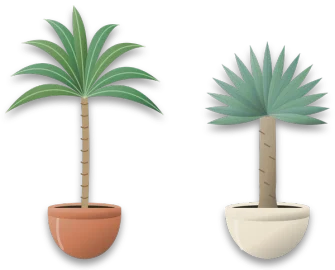
A bare stem topped with a fountain of narrow leaves is the shape of both a dracaena and a yucca, and shops sell both as a “palm” for a corner or a hall. The shape is where the likeness ends. They come from different places, they want different light, and they drink on different schedules, so it pays to know which one has come home with you.
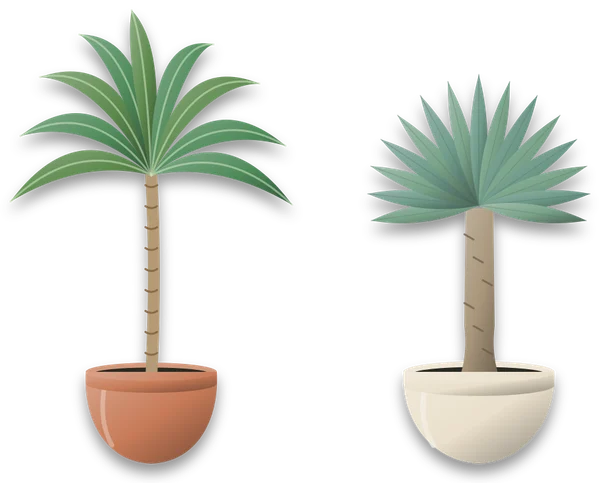
The one minute test
Feel the leaf. NC State Extension describes the corn plant’s leaves as long, narrow and pointed, with entire margins, which means smooth edges, and a prominent midrib. It says the leaves droop as they get longer, and that the base clasps or sheathes the stem. The RHS says dracaenas have a fountain of narrow, glossy leaves. Run a finger along the edge and you should feel nothing catch. The houseplant yucca is stiffer. NC State Extension describes Yucca gigantea leaves as sword shaped, stiff, leathery and smooth, pale green to bluish green, in spiral rosettes, with margins that may be entire or have small teeth. The RHS calls yucca leaves stiff and sword shaped, forming rosettes.
Check the tip. This journal’s entry says the yucca sold as a houseplant is nearly always Yucca gigantea, which NC State Extension describes as soft tipped and flexible, and which is also called spineless yucca. Its garden cousins are another matter. The RHS says Yucca aloifolia has sharp-pointed leaves and Yucca gloriosa has spine-tipped ones. A plant sold for a border may be one of those, so press a leaf tip before you put it by a doorway.
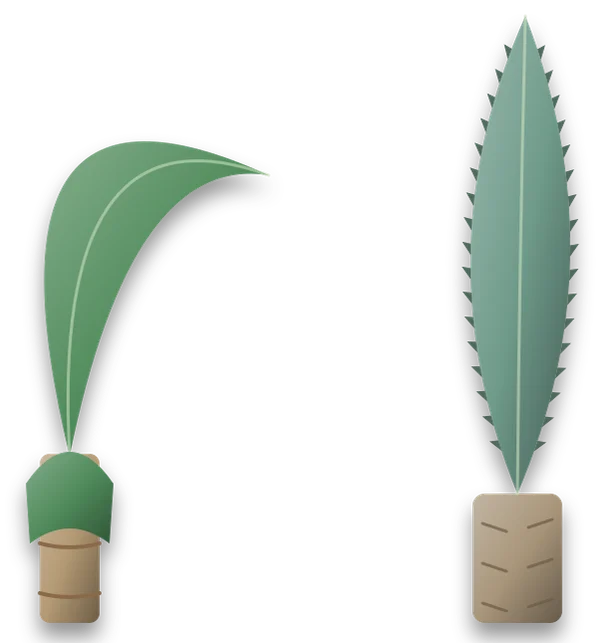
Look at the trunk. NC State Extension describes the corn plant’s stem as unbranched and woody, tan, and about 5 cm across. The RHS says dracaenas start as a rosette at ground level and then build a woody trunk, reaching 2 m or more. A yucca’s trunk is thicker. NC State Extension describes Yucca gigantea as having a thick, woody trunk with light grey bark and an enlarged, flared base. The RHS says larger yuccas gradually lose their lower leaves to expose a trunk.
Flowers will not help. Neither flowers readily indoors. NC State Extension says the corn plant rarely blooms as a houseplant, and that its white flowers are highly fragrant at night. It says houseplant yuccas rarely flower, and that the blooms are creamy white and bell shaped on tall stalks.
Colour is a weak clue. Dracaenas are often striped. NC State Extension says the corn plant’s leaves are glossy green, sometimes variegated white or yellow with a central stripe, and the dragon tree entry describes narrow leaves edged in red. The corn plant entry covers the other common dracaena. A yucca’s leaves are pale green to bluish green, and they stand out stiffly.
Where each one comes from
NC State Extension gives the corn plant’s native home as tropical Africa, and lists its former names Dracaena deremensis and Dracaena massangeana. The dragon tree has its own entry in this journal, and so does Dracaena reflexa, a close relative. NC State Extension lists Yucca gigantea as native from Central Mexico to Central America, with the older names Yucca elephantipes and Yucca guatemalensis and the common names giant yucca, soft-tip yucca and spineless yucca. Outdoors it can reach 4.5 to 9 m. NC State Extension says houseplants stay much more compact.
Where the care differs
Light. The RHS says to give dracaena bright but indirect light, in an east or west window, or a south facing one behind sheer curtains in the northern hemisphere, and to shield it from strong summer sun, which can scorch the leaves. For yucca, the RHS says indoors to give bright, filtered light, with a sunny spot all year, and adds that shade protects it from harsh summer sun. In practice yucca is the plant for the sunniest window, which is a north facing one in the southern hemisphere, and dracaena sits a step back from it.
Water. The RHS says to water dracaena only when the top 5 cm of compost is dry, and to use rainwater or filtered water. It also says the fluoride in tap water can damage the foliage and cause brown tips, and that constantly wet compost leads to root rot. For yucca, the RHS says to water freely in the growing season in a container, to water sparingly in winter, letting the top 5 cm dry out between drinks, and that overwatering causes sudden yellowing and limp lower leaves, in which case the plant should virtually dry out. The dragon tree entry schedules a drink about every 12 days in the growing season and about every 21 in winter. The yucca entry gives about every 14 days and about every 30 in winter. Add either plant to My plants and the scheduler turns those intervals into a calendar for your hemisphere’s seasons. Winter is the cold, short day part of your year: roughly June to August in the southern hemisphere and December to February in the northern.
Warmth and air. The RHS says to keep dracaena consistently warm, at 18 to 30°C, away from cold draughts and radiators, and that these tropical plants enjoy humid air. It gives Yucca elephantipes, the older name of the houseplant yucca, a minimum night temperature of 7°C when dormant. Yucca copes with a cooler, drier room than a dracaena does.
Where the care is the same
Both reshape well. The RHS says dracaenas readily produce new shoots on the stems just below where the cut is made, and says that if a yucca gets too tall you can cut it back by half in spring. Both root from pieces of stem, and the RHS says to take yucca cuttings of 20 to 25 cm in spring and dracaena cuttings in summer, with bottom heat for both. The guide to propagating from cuttings covers the principles.
Feeding is light for both. The RHS says to feed dracaena from spring to autumn with a general liquid fertiliser, taking care not to overfeed, and a yucca in a container gets a balanced liquid feed every fortnight in growth, according to the RHS, and none in winter.
Dracaena is prone to sap sucking pests indoors. The RHS says mottled leaves or poor growth on a dracaena can signal red spider mites, mealybugs or scale insects, and the guides to spider mites, mealybugs and scale insects cover them. The plant finder can filter by light and by pet safety if you are choosing between them for a particular room.
Pets and people
Both are on the ASPCA toxic list. The ASPCA rates corn plant (Dracaena fragrans) and Madagascar dragon tree (Dracaena marginata) as toxic to cats, toxic to dogs and toxic to horses. The toxic principle is saponins, and the signs are vomiting, occasionally with blood, depression, loss of appetite, drooling and, in cats, dilated pupils. The ASPCA lists yucca (Yucca species) as toxic to cats, dogs and horses, also from saponins, with vomiting in cats and dogs and, in horses, liver disease and dermatitis. If a pet has eaten any of it, call a vet, and read what to do if a pet eats a plant.
The RHS says all parts of a dracaena are toxic and that dracaenas are poisonous to cats and dogs, so place them out of reach of pets and young children. NC State Extension says the sap of the corn plant may cause skin irritation and the sap of the yucca can cause minor rashes, so gloves are sensible when cutting either.
Does it matter which you have?
Yes, because they fail in different ways. The RHS says overwatering a yucca causes sudden yellowing and limp lower leaves, and that strong summer sun can scorch a dracaena. Look at the edge of a leaf and the base of the trunk, and then give the yucca the sunniest window and the dracaena a bright spot out of the sun.