Pothos or philodendron: which one is it
About 7 minutes to read. Published . By the House & Hedge team.
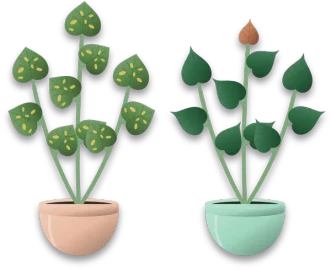
Two vines share the shelves of garden centres, kitchens and offices. One has heart shaped leaves splashed with gold or cream, and the other has plain glossy hearts. Labels are often missing or wrong, and the plants are different genera, though the ASPCA lists both in the arum family, Araceae. A minute with the plant is enough to tell which you own, and the care turns out to be nearly the same. What the identification changes is how much light the plant wants, which of the two will cope with a dim corner, and the name you search under when something goes wrong.
The one minute test
Start with the newest growth, because it is the clue that does not depend on a cultivar.
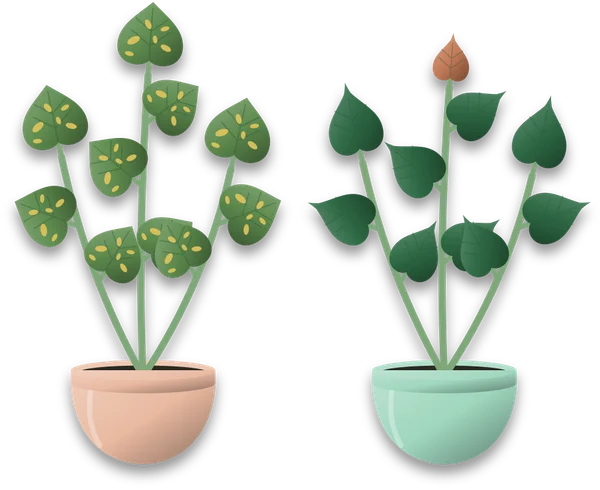
The new leaf. University of Illinois Extension says new leaves on a philodendron are wrapped in a waxy, thin, opaque sheath called a cataphyll, which turns brown and falls away once the leaf has emerged. Pothos has no such sheath. Its new leaves extend from the leaf already there, and they unfurl a lighter green than the older leaves. NC State Extension describes the same thing for the heartleaf philodendron when it lists large, free, lance shaped stipules on new growth and the messy, falling stipules on older growth. So a pale papery sheath around a tip, or a dry brown scrap hanging at a node, means philodendron.
The leaf stalk. Run a fingernail down the stalk that joins a leaf to the stem. NC State Extension says a pothos has slender petioles grooved to clasp the stem, while the heartleaf philodendron’s petioles are not grooved. University of Illinois Extension gives the same test. A groove means pothos, and a smooth round stalk means heartleaf philodendron.
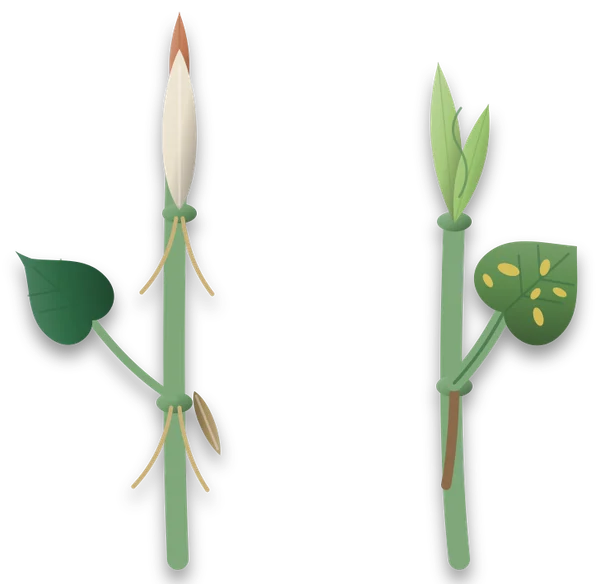
The roots. University of Illinois Extension adds a third clue. A pothos grows one small root at each node, and a philodendron grows more than one at each node. NC State Extension calls these adventitious roots, which arise along the stems and let both plants climb by clinging.
The leaf itself. NC State Extension describes the heartleaf philodendron’s blade as heart shaped, tapering to a point, with a heart shaped base. The blade is glossy above and green or reddish purple below, and new leaves emerge bronze and quickly turn green. Pothos leaves are heart shaped to elliptic, glossy and leathery, and the usual forms carry yellow, cream or white markings. Variegation is a good first guess and not proof, because NC State Extension also lists a pothos called ‘Jade’ that is solid dark green. Size does not help either, since NC State Extension gives about 8 to 15 cm for the leaves of both.
Flowers will not settle it. Both plants flower rarely indoors. NC State Extension says the heartleaf’s flower spike is rarely seen in cultivation, and that pothos flowers are rarely produced indoors.
If two of these clues agree, you have your answer.
Where each one comes from
NC State Extension gives the pothos’s native range as the Society Islands in the Pacific. It has been grown so widely that old labels survive. NC State Extension lists its former name as Scindapsus aureus, and the RHS files the golden pothos under Epipremnum pinnatum ‘Aureum’, so a label may carry either botanical name. This journal also has an entry for dragon tail, a different plant with split leaves, so check the name before you read it.
The heartleaf philodendron grows wild from Mexico to tropical America, according to NC State Extension, whose list of native countries runs from Belize and Cuba to Brazil and Bolivia. Its older names, Philodendron scandens, P. oxycardium and P. micans, still turn up on labels. The RHS describes the species under the name Philodendron scandens as a fast growing tropical evergreen climber.
Which one suits which room
Light is where the two differ most. The RHS says to give pothos bright, indirect light, to avoid direct summer sun, which can scorch the leaves, and warns that too little light can fade the variegation. For the heartleaf philodendron the RHS also recommends bright but filtered or indirect light, yet University of Illinois Extension says philodendrons tolerate very low light while pothos needs higher light levels. Put the two together and the practical advice is that both like a bright room without direct sun, and the philodendron is the one to try in a dimmer hall or bedroom. In low light it grows slowly and the gaps between leaves lengthen. The guide to light, room by room helps you judge what a given room offers.
The plant finder filters by light and by pet safety, which is a quicker way to choose than memorising either entry.
Warmth is similar. The RHS suggests keeping pothos at 18 to 30°C, away from cold draughts and radiators, and gives the heartleaf philodendron a winter minimum of 15°C under glass. Neither plant is built for a cold sill in winter.
Where the care is the same
Water. Both rot if kept wet. The RHS says to water a pothos only once the compost is approaching dryness, after a finger test, and that overwatering can cause root rot. The same holds for the heartleaf. The pothos entry schedules a drink about every 7 days in the growing season and about every 12 in winter. The heartleaf philodendron entry gives about every 8 days and about every 14. Add either to My plants and the scheduler turns those intervals into a calendar for your own seasons. The growing season is spring to early autumn wherever you live, and winter is the cold, short day part of your own year: roughly June to August in the southern hemisphere and December to February in the northern.
Feed. The RHS says to feed pothos about once a month through the growing season with a general houseplant fertiliser, and both entries in this journal advise half strength and nothing in winter.
Pruning and cuttings. The RHS says to cut long pothos stems back to just above a leaf to make the plant bushier, and to take stem cuttings just below a leaf joint and stand them in water. Heartleaf philodendron roots in the same way. The guide to propagating from cuttings has the method.
Pests. The RHS lists scale insects and glasshouse red spider mite for the heartleaf philodendron. If you see either, the guides to scale insects and spider mites cover them.
Climbing. Both climb by their roots. The RHS says pothos can be trained up a moss or coir pole, and a monstera is the better known plant that does the same. A pole is worth adding to either vine if you want bigger leaves and a plant that stays tidy.
Pets and people
Both plants are on the ASPCA toxic list. The ASPCA rates pothos, listed there as devils ivy (Epipremnum aureum), as toxic to cats, toxic to dogs and toxic to horses. It rates heartleaf philodendron (Philodendron hederaceum) the same way. For both, the toxic principle is insoluble calcium oxalates, and the signs are oral irritation, pain and swelling of the mouth, tongue and lips, excessive drooling, vomiting and difficulty swallowing. Keep trailing stems out of reach of a pet that chews leaves. If a pet has eaten any of it, call a vet, and read what to do if a pet eats a plant.
For people, the RHS advises gloves when handling or pruning epipremnums, and lists the heartleaf philodendron as harmful if eaten and a skin and eye irritant. NC State Extension lists contact dermatitis for both.
Does it matter which you have?
For care, very little. Water by the finger test, give bright light without direct sun, feed lightly in the growing season and rest the plant in winter. The two things worth knowing are the light, since a pothos fading to plain green is asking for a brighter spot and a heartleaf philodendron putting out long bare stems is asking for the same, and the pets, since neither plant is safe. If you are choosing a plant for a house with a cat or a dog, pick something that is not listed as toxic, and use the finder to check.