Spekboom or jade: which is which
About 7 minutes to read. Published . By the House & Hedge team.
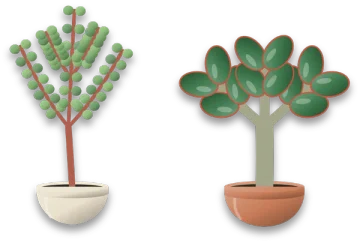
Two succulents from the dry east of South Africa get mixed up. One is the familiar houseplant. The other is the plant that southern African gardeners clip as a hedge and that restoration projects plant out in dry thicket. Both are fleshy, both root from cuttings, and both like bright, dry conditions, so the confusion is natural. A glance at the leaf settles it.
The one minute test
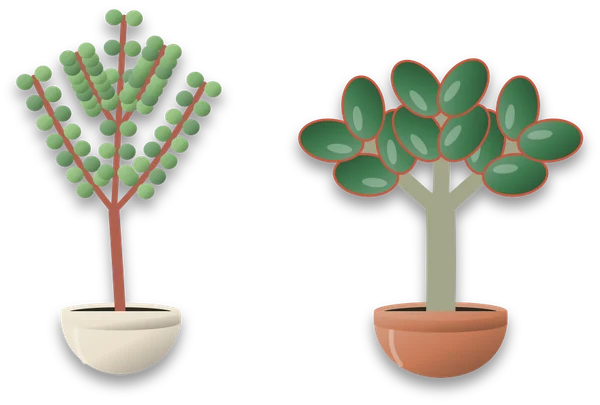
Leaf size. SANBI PlantZAfrica describes the jade plant’s leaves as glossy, dark grey-green and oval, roughly 30 to 90 mm long and 18 to 40 mm wide, often with a reddish edge. The RHS agrees on rounded, fleshy dark green leaves often edged with red. Spekboom’s are small by comparison: the RHS calls them small, thick and glossy, and PlantZAfrica describes small, round, succulent leaves on red stems. Put a leaf of each side by side and the jade leaf is the larger by a wide margin.
The stems. The RHS says spekboom has greyish bark on its mature stems, while young stems are often tinged with red, and PlantZAfrica also names the red stems. Jade is a bulkier plant. The RHS calls it an evergreen, spreading, branched succulent sub-shrub, and left alone for decades it builds a thick trunk, as the jade plant entry describes.
Size and shape. PlantZAfrica gives spekboom as a shrub or small tree of 2 to 5 m in the wild, usually 1.5 to 2 m in a garden, and jade as a rounded evergreen shrub of 1 to 3 m. The RHS gives 1.5 to 2.5 m for both and 10 to 20 years to maturity for spekboom against 5 to 10 for jade.
The flowers. Flowers help only if the plant blooms. PlantZAfrica says spekboom bears small pink star-shaped flowers from late winter to spring, while the RHS describes tiny saucer-shaped pale pink flowers in clusters at the stem tips in summer. For jade, PlantZAfrica says pale pink, star-shaped, fragrant flowers appear in tight rounded clusters from June to August, which is the southern winter, and the RHS says flat clusters of white or light pink flowers in late summer, in a northern climate.
Where it grows. A plant in a hedge or growing wild on a hillside in the Eastern Cape is much more likely to be spekboom. A plant in a pot that has grown a thick trunk and big leaves is a jade.
Where each one comes from
Plants of the World Online at Kew accepts Portulacaria afra, in the family Didiereaceae, and gives its native range as southern Mozambique to South Africa, with a record from north-west Kenya. PlantZAfrica says it grows on rocky slopes and in dry valleys in eastern South Africa, extending into Mozambique, and rates it Least Concern on the national Red List. Its names include porkbush, elephant’s food and spekboom in English, olifantskos in Afrikaans and iGqwanitsha in isiXhosa, and the RHS adds elephant bush, rainbow bush and tree purslane.
PlantZAfrica says the jade plant is a prominent part of valley thicket in the Eastern Cape and KwaZulu-Natal, usually on rocky hillsides, with records from Willowmore to East London, north to Queenstown and into KwaZulu-Natal. It is widespread and not declining. PlantZAfrica names a look-alike, Crassula arborescens, confined to the Little and Central Karoo, with a waxy bloom and nearly spherical leaves. The ASPCA lists that species, as Chinese jade or silver jade, among the plants toxic to cats.
Several other southern African succulents have entries here, among them string of pearls, gasteria and zebra haworthia, and the guide to six southern African houseplants covers the group.
Which one is planted for carbon and hedges
That is spekboom. PlantZAfrica says it is effective in carbon sequestration in semi-arid landscapes and thicket vegetation and is being used for restoration. It says it can be used as a screen or a clipped hedge, in full sun or semi-shade, in dry areas or even in a well watered flowerbed. PlantZAfrica says it is highly favoured as food by game, including elephants, and by livestock, and SANBI says the leaves are slightly acidic and edible for people and animals. Mature plants tolerate a moderate degree of frost, according to PlantZAfrica, while the RHS rates it H1B, which means outdoors in summer only in Britain, with a minimum of 10 to 15°C. Treat it as frost tender in a pot.
PlantZAfrica says cuttings or truncheons root easily and can be planted straight into the ground where they are to grow.
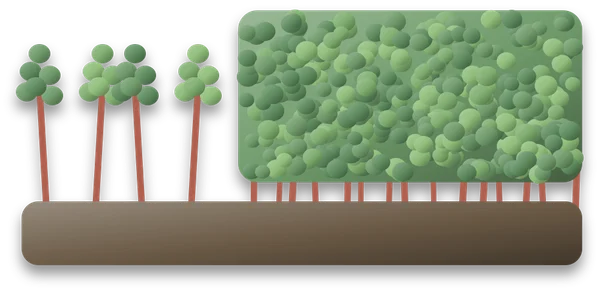
The carbon claim is about landscapes and thicket. It does not say that a plant in a pot does anything for the climate, and a published study of spekboom restoration across South African succulent thicket found that herbivory and the misidentification of target habitat constrain how well region-wide plantings succeed. Plant it for a hedge, for wildlife or for the pleasure of a tough plant, and look at the site before you plant it out for any larger purpose.
Which one is the money plant
The jade plant. PlantZAfrica says growers in the Far East, Germany and the United States have traditionally grown it in decorative tubs for financial luck, which gave it names such as money tree, penny plant, dollar plant and tree of happiness. The RHS lists friendship tree, jade tree and money tree. PlantZAfrica gives kerky bush and pink joy in English and plakkies and kerky in Afrikaans, and the ASPCA lists it as Crassula argentea, with baby jade among its other names.
Money plant is a loose name. This journal lists it as an alias for the jade plant, for pothos and for dragon tail, so check the botanical name on the label. If your money plant trails and has heart shaped leaves, read pothos or philodendron instead.
Where the care is the same
Both plants want bright light, free drainage and a long dry spell. PlantZAfrica says jade needs well drained soil, grows in full sun or semi-shade but flowers best in sun, wants sparing water and rots in waterlogged ground. The RHS says to grow spekboom in very free draining compost such as cactus compost, in bright indirect light, to water it thoroughly from spring to autumn and to keep it nearly dry the rest of the year. The jade plant entry schedules a soak about every 14 days in the growing season and about every 30 in winter, and says to lift the pot to judge it. Add a jade to My plants and the scheduler turns that into a calendar for your hemisphere. Winter is the cold, short day part of your own year, which is roughly June to August in the southern hemisphere and December to February in the northern, and both plants want the watering eased back then.
Both root from cuttings. The RHS says to take spekboom softwood cuttings in spring, using bottom heat, and to root jade from stem, leaf or root cuttings in spring, while PlantZAfrica says jade cuttings root best in summer. The guide to propagating from cuttings has the method for cut succulents, which must callus before they go into compost.
Where the care differs
Warmth is the main difference. The RHS rates jade H2, which means it tolerates a minimum of about 1 to 5°C but cannot survive being frozen, and spekboom H1B, with a minimum of 10 to 15°C. Light also differs a little: the RHS says jade wants full sun, while spekboom does well in full sun or partial shade. For pests, the RHS lists mealybugs, vine weevils and aphids for jade and scale insects for spekboom, so the guides to mealybugs and scale insects cover the likely troubles. The plant finder can filter by light, if you are choosing a spot.
Pets and people
The ASPCA toxic and non-toxic plants list rates jade plant (Crassula argentea) as toxic to cats and toxic to dogs, and to horses, causing vomiting, depression and incoordination. The toxic principle is not identified, which is a reason for more caution rather than less. If a pet has eaten any of it, call a vet, and read what to do if a pet eats a plant.
For spekboom the answer is not known. The ASPCA toxic and non-toxic plants list has no entry for spekboom or elephant bush (Portulacaria afra), so the rating for cats and for dogs is unknown, and this plant is not listed as safe until the entry has been checked. That SANBI calls the leaves edible for people and animals describes its use as food, and it is not a pet safety rating. The RHS page for spekboom lists no toxicity warning, which is also not a rating. If a pet has eaten any of it, call a vet.
Does it matter which you have?
For a pot on a sunny sill, only a little: both want the same care, and the main differences are the cold tolerance and the pets. For the garden it matters a great deal, because only spekboom is the plant of thicket restoration and clipped hedges. If a label says money plant, it may be a jade, a pothos or another plant, so check the botanical name.